Featured update

Among the thousands of missing people are 10 Tibetan tour guides, who worked near the border.
Video
Credit: RFA Tibetan

US Agency for Global Media
News and Information from Around the World
Select a language and narrator voice before playback.
Among the thousands of missing people are 10 Tibetan tour guides, who worked near the border.
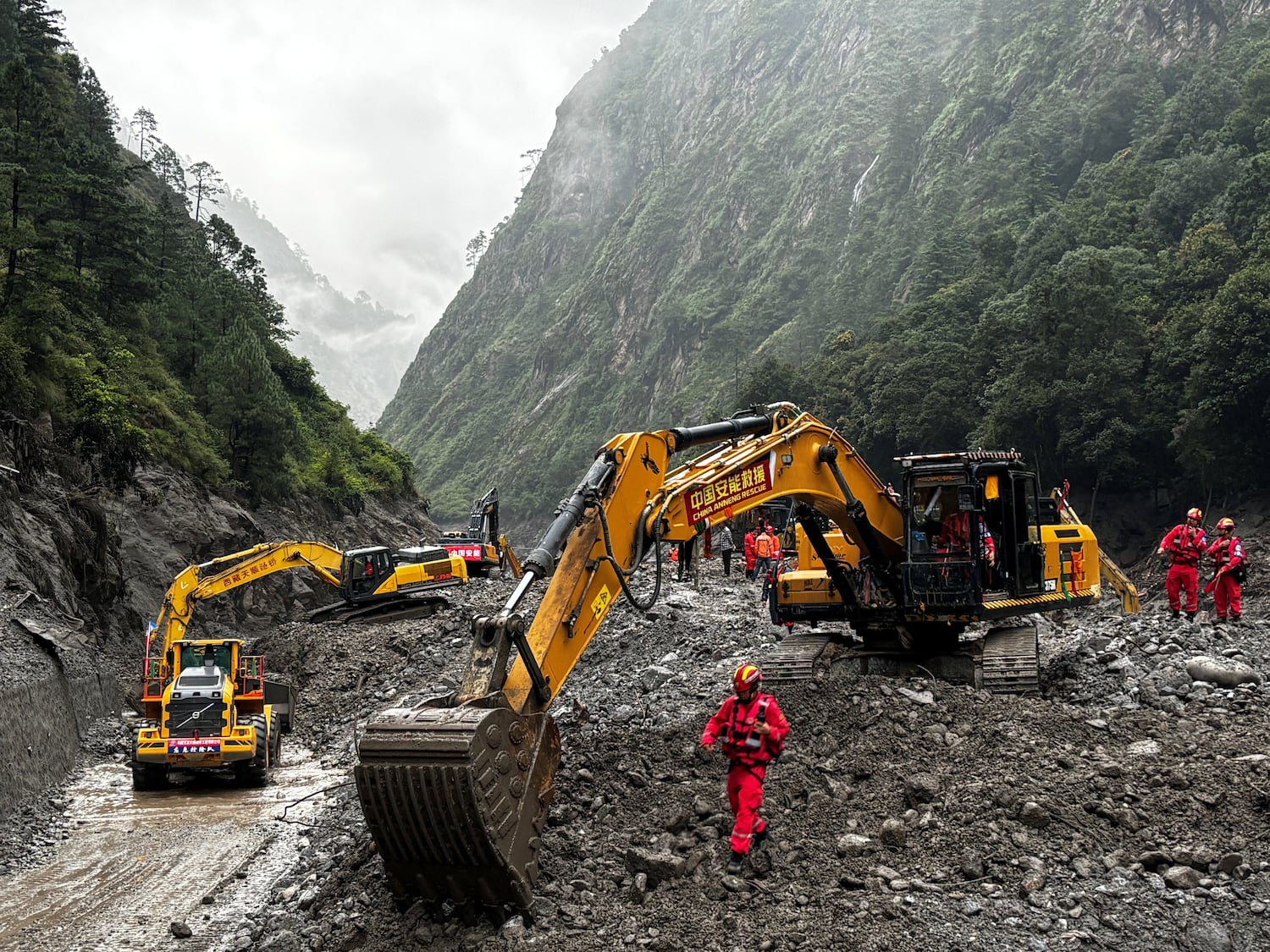
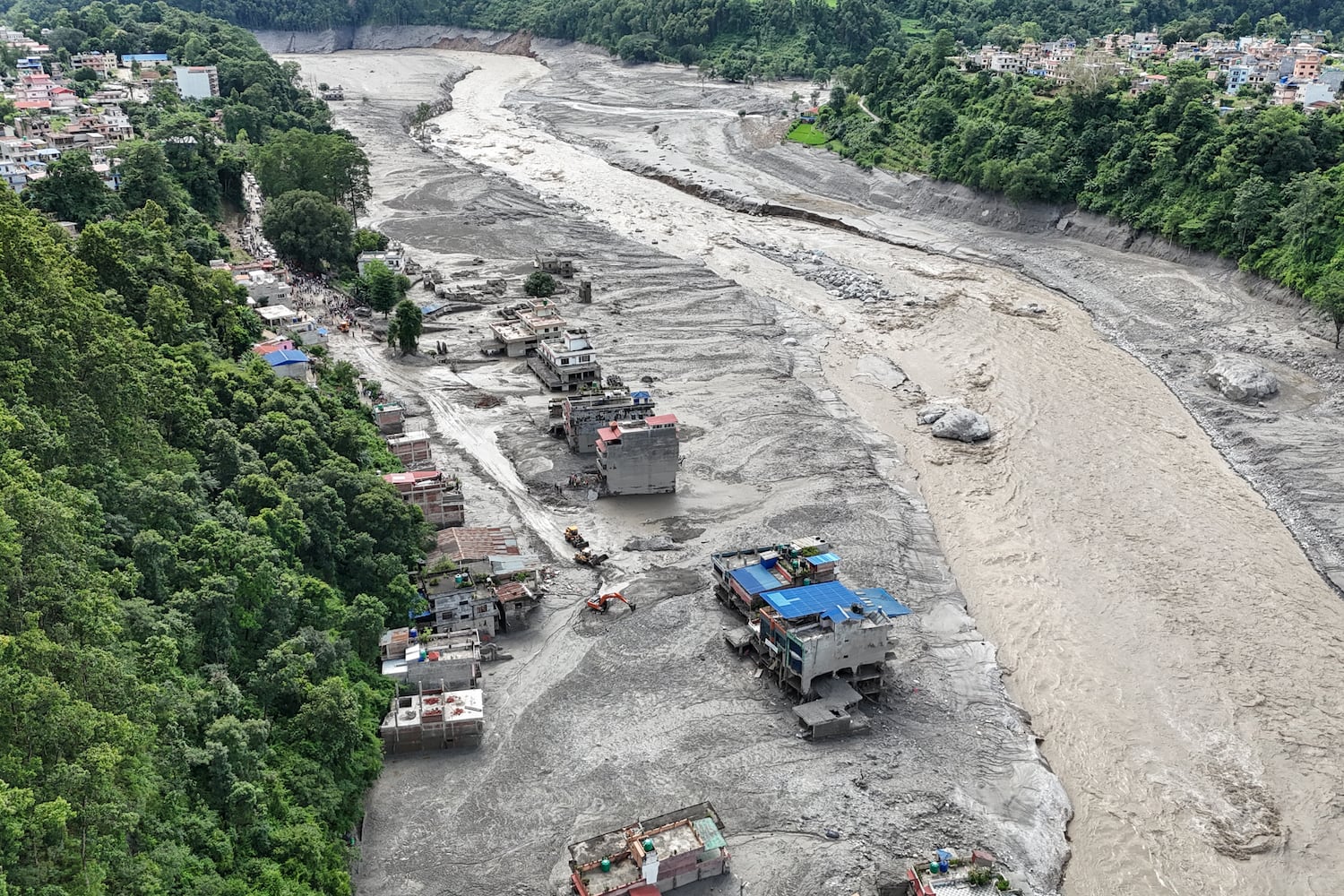
As the death toll from last week’s glacial flooding disaster at the Tibet-Nepal border surpassed 1,000 on Tuesday, sources inside Tibet told Radio Free Asia that a group of 10 Tibetan travel guides are among the missing. AFP reported that more than 4,500 people were missing, but both the death toll and the number of missing could be higher, as exiled Tibetans and advocacy groups have accused China of underreporting casualty totals on the Tibetan side of the border. Chinese authorities have forbidden journalists from entering the disaster zone or interviewing affected family members, and have punished those accused of “spreading rumors” about the disaster, New York-based Human Rights Watch reported. Residents and officials of Kyirong County (Gyirong in Chinese), which borders Nepal’s Rasuwa district, witnessed entire villages destroyed, they told RFA Tibetan on condition of anonymity for security reasons. “Within 3 minutes the flood reached the area near the Kyirong customs office, and no one who was there survived,” a Tibetan resident of Kyirong County told RFA. “There were about 30 people in the village.” The resident said that many people from the area had been working in the area on road construction at the time of the disaster. “Now, many of them are dead,” the resident said. “There is no hope left. It was like a dream. It came out of nowhere.” A Chinese official in the same area confirmed that several people who were displaced by the disaster were able to find alternative lodging. “A few people from the affected area have been kept in a guesthouse and in paying guest rooms in private homes,” the official told RFA. “I am not comfortable explaining other details.” Missing guides Ten Tibetan travel guides from the Tibetan capital Lhasa, the surrounding areas, and elsewhere have been missing since the flood, another Tibetan resident told RFA. The source said that the guides were stationed in the Dram (Zhangmu) area along the border. “They usually take travellers and tourists from the Nepal-Tibet border and take them on excursions and pilgrimage to places like Mount Kailash and Lake Manasarovar,” the second resident said. Two people from the village of Resuo survived the disaster according to a third Tibetan resident, also from Kyirong. An aerial view shows a torrent of muddy water surging past houses and through the Trishuli River in the aftermath of flash floods at Trishuli Center in Nepal's Nuwakot district on Sept. 1, 2026. (Arun Sankar/AFP) “Two people were able to run toward the mountain,” the third resident said. “Only if you can run toward a hilltop can you save yourself; otherwise it is very difficult to survive. The force of the water was so strong.” According to the third resident, Kyirong county was largely spared because it is a bit farther from the affected area. “But the water flowed about three kilometers upstream,” the third resident said. “About 15 families from the village had their homes completely destroyed” The third resident said that many of the people who work there are in the military or are customs officials that work on the border. “We … are also not allowed to visit the affected area,” the third resident said. “All we can do is console the family members.” Stories of survival On the Nepal side of the border several residents told RFA, on condition of anonymity to speak freely, that they witnessed the disaster as it happened. “The flood came like a fall from the sky and felt like an earthquake,” a resident of Serthang, a subdistrict of the town of Timure in the affected area on the Nepal side, told RFA. “I saw the flood coming down and entering my home at the same time.” The Serthang resident said that several villagers were at the family home to celebrate the birth of a son. “Thankfully, we were all able to run and escape,” the Serthang resident said. “But there were many older people and children who could not escape because they lacked physical strength.” Nepali army soldiers move a survivor following flash floods and a mudslide near the Nepal-Tibet border in Nepal, Aug. 27, 2026. (Nepali Army/Reuters) A second Serthang resident told RFA that he saw his elderly mother washed away in the flood. “Before the flood, my wife and I were with my 98-year-old mother,” the second Serthang resident said. “I had to leave my mother behind and saw her swept away by the water in front of my eyes. My wife barely escaped the floodwater.” The second Serthang resident said that within two minutes the village was lost to the carnage. “The electricity had gone out sometime before the flood came,” the second Serthang resident said. “Then suddenly, the whole village was filled with people shouting. In two minutes, the whole village was flooded. I was so scared that I had to run barefoot.” A flood of this magnitude was unprecedented for the area, the second Serthang resident said. “The height of the flood was as high as a tall building,” the second Serthang resident said. “It seemed like the water was in the sky. In the meantime, the house was no longer visible.” Edited by Eugene Whong
Advocates call on Chinese authorities to allow information transparency in Tibet’s rescue and relief efforts.
Satellite imagery taken at the Nepal-Tibet border shows extensive destruction from flooding and landslides that inundated the area Wednesday leaving hundreds of people dead or missing, but information from the Chinese-controlled side of the border is severely lacking, Tibetan rights activists told Radio Free Asia. Satellite imagery shows extensive damage from Nepal-Tibet border floods A comparison of imagery taken Aug. 23 and Aug. 27 of Tibet’s Kyirong County (Gyirong in Chinese), and Nepal’s Rasuwa district, shows that customs buildings, a bridge and other infrastructure on the border appear to have been swept away in the carnage. Restaurants, hotels, homes, and other buildings downstream on the Nepal side also appear to have been destroyed or washed away. Further downstream, much of Timure village appears to have disappeared in the latest imagery, underscoring the scale of the disaster and raising concerns about casualties and property loss. China’s state-run Xinhua news agency reported that the disaster also caused extensive infrastructure damage — about 3 kilometers (2.8 miles) of the G216 highway leading to Kyirong Port were damaged, and five telecommunications base stations initially stopped operating. The Chinese government is severely restricting detailed information about the situation inside Tibet, Ryan Fioresi, executive director at Washington-based International Campaign for Tibet, or ICT, told RFA citing sources on the ground. “Chinese authorities have relocated local residents, barred journalists, independent observers, and others from entering the affected area, and prevented reliable firsthand information from emerging,” he said. “As a result, the international community remains largely dependent on Chinese state media, whose coverage has focused primarily on Xi Jinping’s directives and official accounts of rescue and relief efforts, rather than the actual conditions on the ground, survivors’ experiences, or the full extent of the casualties and destruction.” Lobsang Yangtso, a senior environmental researcher at the International Tibet Network, said she was concerned that the Chinese government has been engaged in large-scale construction projects in Tibet, a region that is geographically vulnerable to disasters such as earthquakes and flooding. She called on Chinese authorities to publicly and transparently release information about casualties and missing people. In total, at least 1,468 people were missing and 392 were confirmed dead according to AFP at the time of writing. On the Nepalese side, the disaster has also devastated Tibetan communities in Rasuwa district. As of August 27, Chinese authorities said three people had died and 558 were missing in Kyirong County. At the time of the disaster, hundreds of people were believed to be in the vicinity of the Kyirong border crossing including villagers, border staff, freight and construction workers, merchants, and non-Chinese citizen tourists. Tibetan casualties in Nepal Sources within the Tibetan diaspora told RFA that many Tibetans living in Nepal were affected by the disaster. The homes and property of five Tibetan households in the town of Timure were swept away by floodwaters, according to a statement from the Tibetan Refugee Welfare Office in Nepal. Members of two Tibetan families remained out of contact, while members of three other families escaped to higher ground and survived. Damaged road leading to Kyirong Port following a mudslide, in Shigatse, Tibet Autonomous Region, Aug. 27, 2026. (China Daily via Reuters) In the Gegyeling Tibetan settlement in Rasuwa district, 11 houses and the surrounding area were swept away. The whereabouts and condition of some of the residents remain unclear. Sources familiar with the situation also told RFA that floodwaters swept away a Tibetan in the Shabrubesi market area, also in Rasuwa. Sikyong Penpa Tsering, president of the Central Tibetan Administration, the exile government in Dharamshala, India, later reported the same statistics, adding that in Gegyeling, two elderly residents were still missing. He also provided an update on the situation in Shabrubesi, which he said was largely swept away, one Tibetan was killed and three others remained missing. In Timure, he said, six people from two Tibetan families were reported missing. Nepalese authorities had rescued six Tibetans as of the morning of August 27, Tsering said. Three other Tibetan settlements in Nepal — Thangpoche, Khangjim and Biritim, also known as Briddim — were not affected because their homes are located at higher elevations. The Dalai Lama, Tibet’s exiled spiritual leader, expressed his condolences Thursday, acknowledging that the disaster had caused heavy damage and loss of life. “I hope that appropriate follow-up measures will be taken, wherever possible, to help ensure that such disasters do not recur,” he said. The exact cause and sequence of the disaster remains under investigation and experts cautioned against prematurely describing the disaster as simply a glacial collapse, as many international media outlets had been reporting. The evidence points to a very large slope failure involving both rock and glacier ice on the northern side of the Langtang Lirung massif, Tenzing Chogyal Sherpa, a physical geographer at Utrecht University in the Netherlands, told RFA. “What is clear is that this was not simply a conventional river flood,” Sherpa said. “A very large volume of rock and ice moved rapidly downslope and entered the river system, producing an extraordinary amount of debris and sediment.” He said he preferred the more cautious term “large rock-ice avalanche” until further evidence is available. Tibetan blackout The Chinese government deployed hundreds of emergency responders, firefighters, engineers and military personnel to the area, China’s state-run Xinhua news agency reported. Authorities are also monitoring a landslide-dammed lake upstream from the border crossing. Xinhua reported that the water level had risen compared with the previous evening, raising concerns about a possible secondary disaster. Experts and advocates told RFA that they are calling for better monitoring of high-altitude source areas, stronger river-level early warning systems, rapid communication between upstream and downstream communities, and, particularly in transboundary river basins, much stronger sharing of information across borders. Nepal’s rescue efforts on its side of the border are more transparent than the Chinese government’s response on the Tibetan side, Tencho Gyatso, president of ICT, told RFA. “While Nepal is providing timely information and avenues for international humanitarian assistance, we hope that, in Tibet, disaster relief efforts will be accompanied by timely and transparent information and unhindered access for humanitarian support,” she said. Edited by Eugene Whong.
Advocates say China razes monks’ homes to restrict religious freedom and further ethnic unity law’s reach in Tibet.
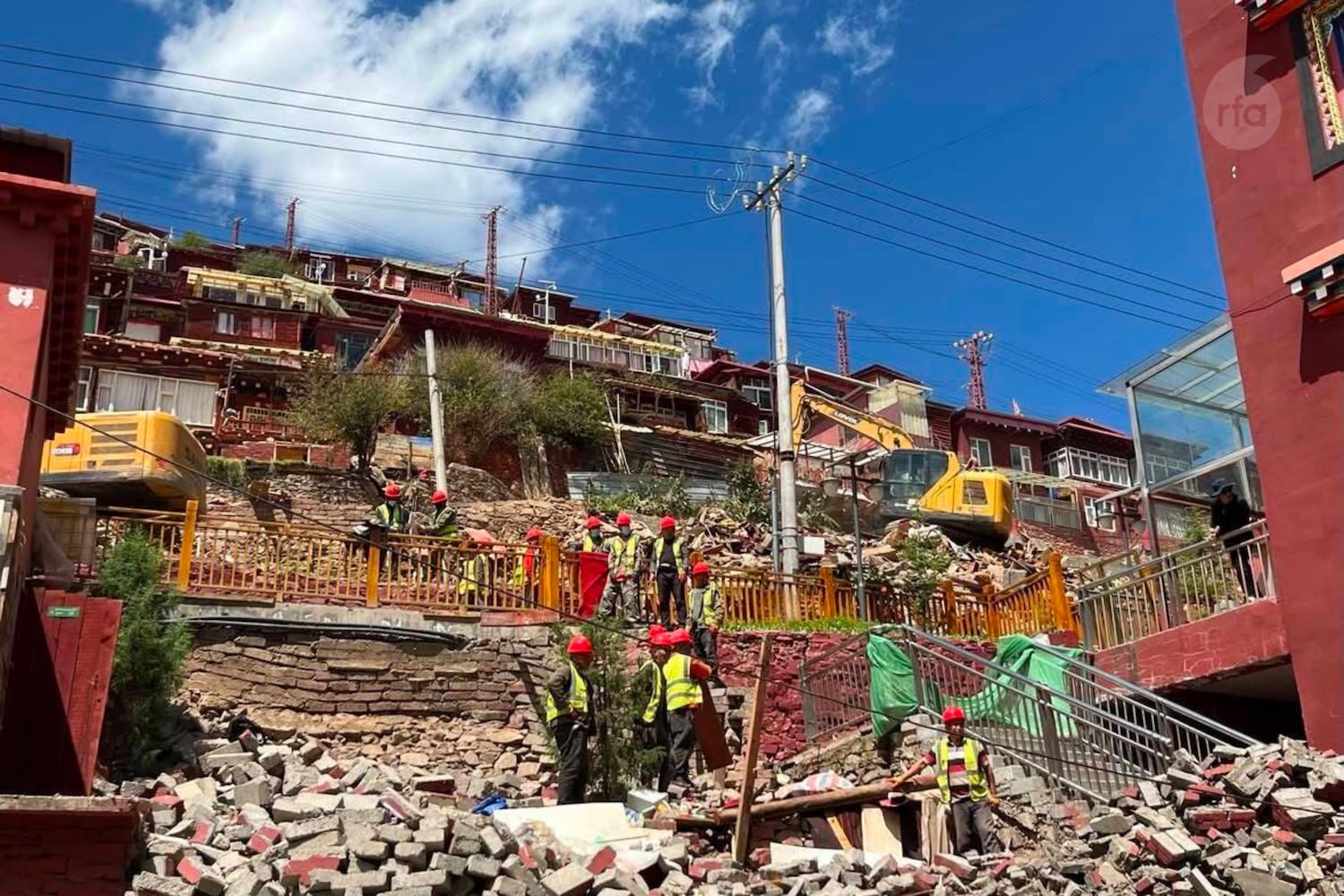
Chinese authorities in Tibet have over the past month continued and expanded demolition of the Larung Gar Buddhist Academy , satellite imagery analyzed by Radio Free Asia shows. It is the latest in a series of moves by Beijing to downsize the major center of Tibetan Buddhist learning which at its peak in the early 2000s was home to 40,000 Buddhist monastics. Last year, Chinese authorities expelled thousands of Tibetan monks and nuns from Larung Gar, which is in Serthar county (Seda in Chinese) within the Kardze (Ganzi) Tibetan Autonomous Prefecture of Sichuan province. Sources at the time said that thousands of homes had been marked for demolition. The demolitions have been carried out in separate phases since 2001, according to the Central Tibetan Administration, or CTA, the official government-in-exile located in Dharamsala, India. This time, at least 1,060 residences belonging to monks and nuns are targeted for demolition, which appears to have begun around July 13, Tenzin Pema, director of strategic communication at the Washington-based International Campaign for Tibet, or ICT, and formerly RFA Tibetan director, told RFA. “RFA’s August 14 imagery appears to show clearance spreading around the academy’s central area, supporting our July 17 report that a new demolition campaign began around July 13,” Pema said. “The current campaign raises fears of another major assault on Tibetan Buddhist religious, cultural, and educational life.” ICT is concerned that this latest round of demolitions at one of the largest Tibetan Buddhist centers in the world represents a further tightening of restrictions on religious practice, Pema said. Cultural nexus Established in 1980 to revive Buddhist scholarship, Larung Gar has grown into one of the world’s largest centers for Tibetan Buddhist learning. Over the decades, it became one of the most influential centers for the study of Tibetan language, culture, and religion, attracting thousands of Chinese Buddhist practitioners, in addition to Tibetans. The current phase of demolition follows an earlier one about a decade ago, where Chinese authorities destroyed half the compound and sent away thousands of monks and nuns, over what authorities said were overcrowding and fire-safety concerns. Rights groups , however, have said that the demolitions are part of Beijing’s attempt to exert control over religious and educational institutions. Comparing satellite imagery from July 24 and August 14 shows that the demolition area has expanded and that some areas have been cleared of debris. Dump trucks and excavators can still be seen operating at the approximately 2.5-acre (1 hectare) demolition site. (RFA) Satellite imagery captured Aug. 14 confirms that approximately 2.5 acres (1 hectare) has been cleared from a residential area of the academy since demolition started. Dump trucks and excavators remain visible at the site, and demolition is scheduled to be completed by Aug. 20, according to RFA sources familiar with the situation on the ground in Serthar. According to ICT, Larung Gar has been reduced to about half its size through the demolition of dwellings over the years. In 2016 and 2017, about 5,000 monks and nuns were evicted from the academy and nearly 5,000 dwellings were demolished, Pema said. Sources told RFA that last year, after some monks and nuns were expelled from Larung Gar, a number of residences were left vacant. This year, however, some of the residences are reportedly being demolished without public notice. There are also reportedly plans to continue demolishing additional residences next year. A photo received by RFA Tibetan on Aug. 11, 2026, shows demolition work at night at Larung Gar. (Citizen Photo via RFA) Prior to the current round of demolitions, Chinese authorities intensified restrictions at Larung Gar, limiting the number of monks and nuns at the religious institute and expelling some of them, RFA Tibetan reported. The number expelled has not been confirmed, but demolition began in residences that had been vacated under these restrictions. In apparent protest of the demolitions, a monk reportedly displayed a large portrait of the 10th Panchen Lama, from a window of one of the residences. The Panchen Lama is the second most important figure in Tibetan Buddhism after the Dalai Lama. After the 1989 death of the 10th Panchen Lama, the Dalai Lama and the Chinese government spent the next six years looking for his successor, with each appointing a different person . The 10th Panchen Lama is therefore the last person to hold the position to have been recognized by both the Chinese government and Tibetans. Some sources familiar with the situation in Larung Gar told RFA that it remains unclear whether the monk who hung the portrait has been detained by Chinese authorities. Other sources said that the monk has disappeared and his whereabouts are unknown. Tight restrictions on communication between the area and the outside world have prevented confirmation of details, including the monk’s name. A map shows the location of Larung Gar. (ICT) The Chinese government’s demolition of monks’ residences at Larung Gar is a “serious situation” that demands global attention, Tenzin Lekshay, spokesperson for the CTA, told RFA. “Despite China’s widespread claims and propaganda that religious freedom exists in Tibet, the actual situation on the ground clearly demonstrates a lack of religious freedom,” Lekshay said. “The international community must directly protest against the Chinese government.” Increased Surveillance Concurrent with the demolitions, local level authorities have placed restrictions on the number of tourists allowed to visit Larung Gar and limited movement within the academy’s grounds. In a notice issued July 11, Serthar County tourism authorities said road maintenance work leading to Larung Gar would begin on July 13, and that the operating hours of public buses traveling to the site would be temporarily changed. The Serthar County Public Security Bureau also reminded tourists that they must only travel to Larung Gar via official arrangements and are prohibited from entering on their own. Authorities also warned visitors not to trust information provided by people with no connection to the local area and prohibited individuals from bypassing restricted areas or crossing mountains to enter the site independently, according to information obtained by RFA Tibetan. Visitors are reportedly allowed to remain for no more than 90 minutes and must travel on designated shuttle buses. They are also required to rent a small electronic tracking device for 200 yuan ($29). According to sources, the device is used to monitor visitors’ movements, enforce time limits and restrict access to certain areas. People with contacts inside Tibet told RFA that telephone conversations with individuals in and around Larung Gar are believed to be closely monitored by Chinese security authorities, making residents reluctant to speak openly. Sources also said local people are increasingly afraid to answer questions directly about conditions at Larung Gar, adding that this level of surveillance is no longer unique to the area but has become common across many parts of Tibet. Forced unity ICT emphasized that these developments must be viewed against the backdrop of Larung Gar’s recent history and in the context of China’s new Ethnic Unity and Progress Law . The latest demolitions come after China implemented the law, which focuses on reshaping ethnic identity, changing the legal framework around language, expanding state oversight of religion, and extending the law’s reach beyond China’s border. “It is especially concerning that the demolitions began just weeks after the new law came into effect on July 1,” Pema said. “The law codifies broader coercive assimilation policies aimed at erasing Tibetan identity and threatens the future of key centers of Buddhist learning and practice such as Larung Gar.” Edited by Eugene Whong.
The late former premier of China Zhu Rongji wielded the economic hammer during China’s rapid economic rise in the 1990s and 2000s to increase Beijing’s influence over Tibet, an expert told Radio Free Asia shortly after Zhu’s death on Wednesday. Zhu, 98, died at 11:06 a.m. in Beijing of an unspecified illness, the state-run Xinhua News Agency reported. As premier alongside President Jiang Zemin from 1998 to 2003, Zhu had spearheaded China’s accession to the World Trade Organization and ushered in an era of rapid economic growth and full integration into the global market through a series of bold but not fully completed reforms. The pair are credited with orchestrating China’s gradual escape from international isolation following the 1989 Tiananmen Square crackdown and its path to becoming the world’s second-largest economy. But for Tibetans, Zhu’s legacy as an architect of China’s economic rise is one of increasing Beijing’s political control over the region, Buchung Tsering, research director at the Washington-based International Campaign for Tibet, told RFA. “ As part of the Western Development Strategy, Zhu promoted greater economic development in Tibetan areas, seeking to use economic means to maintain ‘stability’ in Tibet and bring Tibetans in line with the Chinese government’s policies,” Tsering said. “Zhu Rongji can therefore be seen as a key figure in strengthening Beijing’s political control over Tibet through economic means.” A Chinese student supporting Chinese Premier Zhu Rongji is knocked to the ground by protesters supporting Tibetan and Taiwanese independence, April 14, 1999 at MIT in Cambridge, Massachusetts. (Jim Bourg/Reuters) The Western Development Strategy was a state-run economic development program that included large scale infrastructure projects intended to integrate China’s western frontier, including Tibet and the Uyghur region, with its booming coastal cities. Critics have said that this policy accelerated the westward migration of the Han population, objectively altering the local population structure and triggering discontent among local ethnic minorities regarding the marginalization of their native culture and the unfair distribution of economic benefits. Overseas Tibetans and Uyghurs have protested this issue on numerous occasions. A Tibetan demonstrator displays a Tibetan flag as they protest Chinese Premier Zhu Rongji near the Chinese embassy in New Delhi, Jan. 15, 2002. (Prakash Singh/AFP) The Western Development Strategy is widely considered to be the blueprint for the Belt and Road Initiative, which is similarly criticized as a means for China to increase its influence, though on a global, rather than national scale. Progress and setbacks Zhu Rongji’s forceful reforms of the overall Chinese economy were accompanied by social pain, including the layoffs of tens of millions of state workers, and the subsequent increased financial pressure on local governments following the 1994 tax-sharing reform. Because the social security system was not yet fully developed at the time, workers suddenly lost their medical, housing, and pension guarantees, triggering massive layoffs and local labor protests, all of which were subsequently suppressed by the government. In addition, during his tenure, the Chinese government launched a severe crackdown on the Falun Gong religious group in 1999, and arrested and sentenced political dissidents and NGOs who attempted to form the “China Democracy Party.” A screen shows a portrait of former Chinese Premier Zhu Rongji who passed away on Wednesday, in Beijing, China, Aug. 12, 2026. (Maxim Shemetov/Reuters) After stepping down in 2003, Zhu Rongji rarely made public appearances, but continued to maintain ties with his alma mater, Tsinghua University. He served as the first dean of Tsinghua University’s School of Economics and Management from 1984 to 2001, a term that lasted 17 years. Since the Xi Jinping era began, many reforms implemented in the 1990s under Zhu’s tenure have been reversed. The Xi Jinping government has vigorously supported state-owned enterprises while suppressing private enterprises and technology companies. Life and career Zhu Rongji was born in Changsha, Hunan Province, in 1928. He graduated from Tsinghua University in Beijing with a degree in electronic engineering. He joined the Communist Party of China in 1949, the same year that Mao Zedong, another native of Changsha, announced the founding of the People’s Republic of China. Zhu Rongji holds a tea leaf during his visit to the Maramba Tea Estate in Limuru, west of Nairobi, Kenya, April 26, 2002. (Pedro Ugarte/AFP) During the political movements of the Mao Zedong era, Zhu Rongji was purged twice. During the Anti-Rightist Campaign in 1958, he was labeled a “Rightist” and expelled from the Party. During the Cultural Revolution, he was again persecuted, and from 1970 to 1975, he was sent to a “May Seventh Cadre School” for labor “re-education.” During the tenure of Jiang Zemin and Zhu Rongji, the Chinese government was recognized for maintaining economic and RMB exchange rate stability during the 1997 Asian financial crisis. Compared to the period under Xi Jinping, the Jiang-Zhu era is also seen by some reformists and observers as a relatively open and optimistic time. Jiang Zemin passed away in November 2022 at the age of 96. However, China’s economic marketization at that time did not bring about corresponding political liberalization. Edited by Eugene Whong from a report by RFA Mandarin . Additional reporting by Tsetan Dolkar and editing by Tawang for RFA Tibetan.
Updated July 27, 2026 at 12:45 ET It’s called the Law on Promoting Ethnic Unity and Progress—China’s newest law under President Xi Jinping, passed on March 12, 2026, and in effect since July 1, 2026. The law contains 65 articles, many of which have raised concerns among Tibetans and rights groups. In this explainer, we focus on four key areas of the law that have drawn the most attention: identity, language, religion, and its reach beyond China’s borders. First, it seeks to reshape how ethnic identity is understood in China . The law calls on Tibetans, Uyghurs, Mongolians, and other ethnic groups to build what it describes as “a strong sense of community for the Chinese nation,” placing a shared national identity at the center of ethnic policy. Second, it changes the legal framework around language . Under Article 15, Mandarin is given priority in education and government affairs. While the law says minority languages are “respected and protected,” it also states that when Mandarin and minority languages are used together, Mandarin should take priority in position and order. Third, it expands state oversight of religion . Article 46 requires religious groups, religious schools, and places of worship to promote a sense of community for the Chinese nation, follow the policy of “ Sinicization of religion ,” and guide religious activities to adapt to socialist society. Critics say this could further increase state control over religious practices, including Tibetan Buddhism. Fourth, and one of the most internationally scrutinized provisions, is Article 63, which extends the law’s reach beyond China’s borders . It states that anyone living outside China could face legal consequences if Beijing determines their actions undermine “ethnic unity” or create “ethnic division.” Beijing frames all of this as protection and development , equal rights for all ethnic groups, and continued investment in poorer regions. Officials point to new schools, infrastructure, and job programs in places like Tibet and Xinjiang as evidence of that commitment. But the law’s reach goes well beyond schools and language. It also links ethnic affairs directly to national security, calling for action against what it defines as separatism, extremism, and terrorism, both inside China and abroad. Critics say the law gives legal backing to policies that were already being implemented in minority regions. They argue that putting these policies into law could allow authorities to enforce them more broadly and with fewer limits. In Xinjiang, this builds on years of mass detention documented in Uyghur communities. In Inner Mongolia, a preview came in 2020, when new Mandarin-language mandates in schools triggered mass protests and a purge of local officials. In Tibet, it builds on existing restrictions around religious teaching and Mandarin-medium education. The concern isn’t limited to human rights groups. In June, the United Nations human rights chief, Volker Türk, called on China to repeal the law, warning it risks violating multiple international treaties China has ratified, and could deepen restrictions on language, religion, culture, and expression for ethnic minorities. Whatever this law is ultimately called—unity or assimilation—it’s now in effect. And its impact is likely to be felt for years to come, in Tibet, Xinjiang, Inner Mongolia, and beyond. RFA Tibetan spoke with regional experts, rights advocates, and a Chinese government spokesperson for their comments on the new law: Frank Lehberger, sinologist “This is however not a recent reversal of policies, but a concretization of legal, ideological and brutally repressive ethnic policy.” Brahma Chellaney, geostrategist “Tibet may see its demographic balance shift in such a way as to make the region indistinguishable from provinces in the Chinese heartland.” “The 2026 law provides the legal framework for breaking up minority-heavy areas by moving Han Chinese into them while relocating minorities into the Chinese interior for ‘labor programs.’” “The likely long-term impact will be the erosion of distinct ethnic identities in favor of a singular Chinese national identity, with Mandarin the sole language of education.” James Leibold, La Trobe University “The deeper impact may be slower and more bureaucratic: minority identity becomes something to be managed, curated and disciplined by the party-state. That is how assimilation often works, not with one grand announcement, but through schools, textbooks, cadres, museums, slogans and forms.” “Truly, the paperwork is where empires go to pretend they are being reasonable. Difference is tolerated rhetorically, but the political direction is toward sameness.” Bhuchung Tsering, International Campaign for Tibet “This law would be the codification of the change in the bilingual education system in the Tibetan areas ... Tibetan schools have at various times been implementing Model One, which means Tibetan language is the medium of instruction. Now, through the imposition of Chinese on the Tibetan people, and with Mandarin becoming the medium of instruction, China is changing the bilingual education system in the Tibetan area, and that will have an impact on the Tibetan people.” Tsemoling Penpa, former political prisoner “The intention behind China’s new Ethnic Unity Law... is the complete erasure of Tibet and Tibetan identity. It’s not only about religion or culture—it is about erasing Tibet as a whole.” Liu Chang, spokesperson, Chinese Embassy in Washington “China is a multi-ethnic country where various ethnic groups are all equal and united in a harmonious relationship of mutual assistance. Article 63 targets unlawful acts that undermine ethnic unity and incite separatism, with the fundamental aim of safeguarding ethnic harmony, social stability, and national security.” “We urge relevant parties to respect the basic facts, stop making unwarranted criticisms and irresponsible remarks on China’s ethnic policies and rule of law, and cease using so-called ethnic issues as a pretext to interfere in China’s internal affairs.” Edited for Tibetan by Tawang and for RFA English by Charlie Dharapak. Updated to condense responses for clarity.
The incident comes one day after China’s ‘ethnic unity law’ came into effect.
The incident comes one day after China’s ‘ethnic unity law’ came into effect.
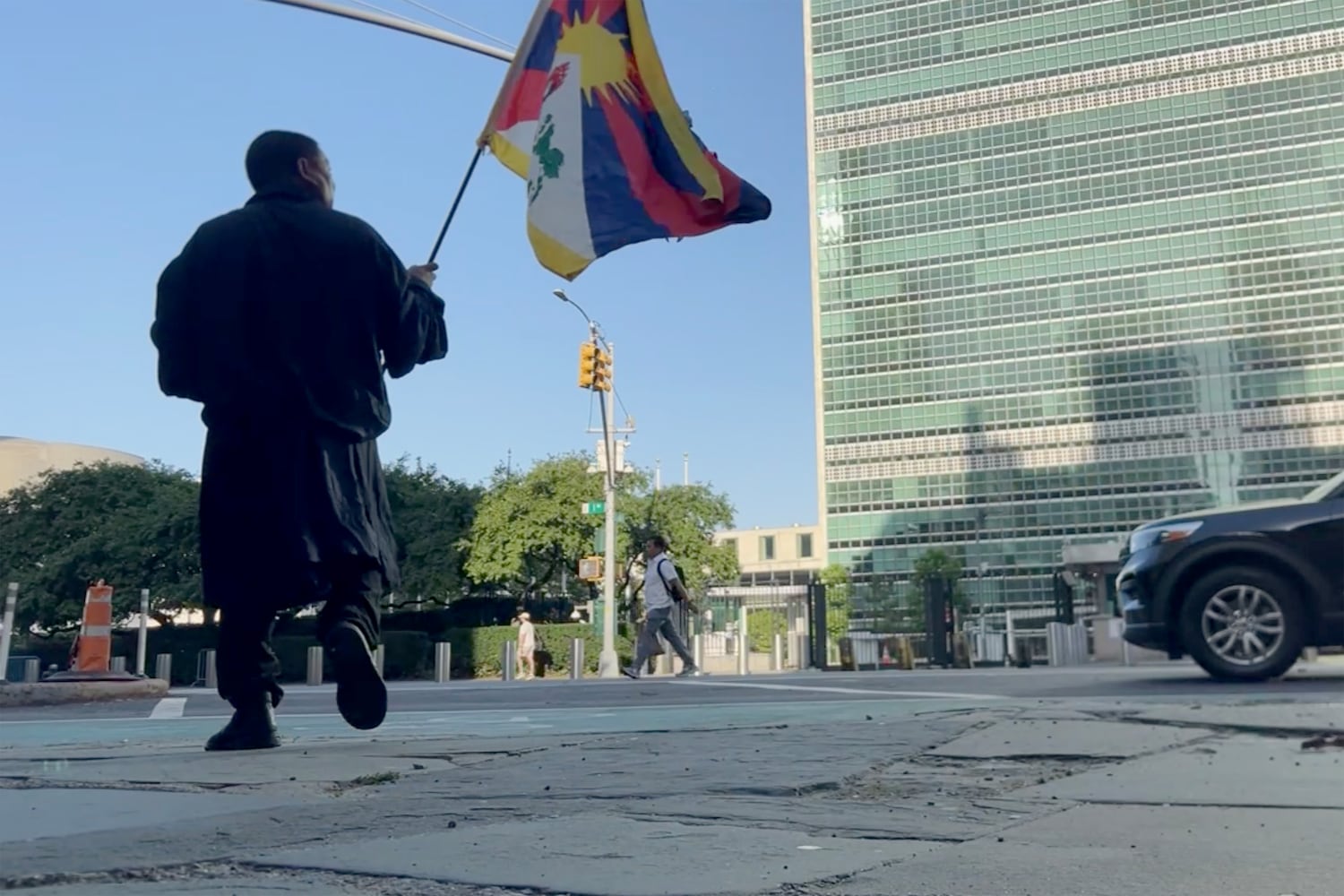
Content warning: This story contains language that readers may find disturbing. A Tibetan activist died Thursday after setting himself on fire outside the United Nations headquarters in New York. Tibetan activist Lobga Rangzen's New York funeral Lobsang Palden, popularly known as Lobga Rangzen, a longtime Tibetan activist based in New York, died at Bellevue Hospital after succumbing to his injuries, Jamphel Choesang, president of the Regional Tibetan Youth Congress of New York and New Jersey, told Radio Free Asia. The self-immolation comes one day after China’s new ethnic unity law went into effect, with critics warning that the law brings accelerated forced assimilation and cultural erasure of Tibetans and Uyghurs. It also brings fears of Beijing’s increasing transnational repression and its ability to stifle dissident voices overseas. “The unfolding genocide inside Tibet and the enforcement of the draconian ‘Ethnic Unity and Progress Law’ on July 1 are what drove Lobga Rangzen to this tragic decision,” Penpa Tsering, head of the Central Tibetan Administration said in a released statement on Friday. Lobga Rangzen poses for a photo in New York in this image posted to his Facebook page on July 2, 2026. (Lobga Rangzen via Facebook) Rangzen was a well-known Tibetan activist who participated in demonstrations and campaigns calling for Tibetan freedom and raising awareness of human rights issues under Chinese rule. Before the incident, Rangzen posted a Facebook video where he spoke about the situation in Tibet and the importance of efforts to preserve Tibetan language and culture. He also criticized Chinese government policies in Tibet, which he described as an “erasure” of Tibetan identity, and urged Tibetans in exile to increase their efforts in their struggle. Content warning: Below is language that readers may find disturbing. In a subsequent Facebook livestream post, Rangzen propped the camera on the sidewalk and walked a few steps to a traffic median across from the U.N. building and placed a large Tibetan flag on a traffic post. Moments later, he set himself on fire. In the video, cars were seen driving past on First Avenue, honking their horns. Rangzen fell to the ground. Two men in security uniforms reached him a minute and 10 seconds later with fire extinguishers. Lobga Rangzen in an undated photo. (Lobga Rangzen via Facebook) Tibetans have previously committed acts of self-immolation to protest against Beijing’s policies in Tibet and regions with large Tibetan populations in exile. Penpa Tsering said that from 2009 to around 2022, roughly 157 Tibetans have self-immolated inside Tibet, referring to this act as “offering of the body” for the Tibetan cause. Thupten Choenyi, a friend of Lobga Rangzen, told Radio Free Asia: “About 15 minutes before he set himself on fire, I had a video call with him on WhatsApp. It was around 5:30 P.M. Unlike our previous conversations, he spoke very quietly and sounded deeply disappointed. He told me, ‘I think China will never listen to us.’” “He was smoking during the call, and I told him not to smoke. He replied that he doesn’t drink, but he does smoke. He was also sipping from a Coke bottle, and his T-shirt was wet. I asked him where he was, and he said he was in front of the United Nations.” “Then he suddenly asked, ‘Can I take a screenshot of our video call?’ I said yes, and he sent it to me immediately. A short time later, he set himself on fire. He also called a few of his close friends before carrying out the act. I am very sad right now.” Penpa Tsering, leader of the Central Tibetan Administration, speaks to reporters in Dharamsala, India, July 3, 2026. (Tenzin Dhonyoe/RFA Tibetan) Penpa Tsering, attending the International Tibetan Youth Conference in Dharamsala, India, said that Rangzen had always carried the Tibetan cause and devoted his time to it in New York. He said that wherever it happens, inside or outside Tibet, those who give their lives for the Tibetan cause must be remembered. He announced that the Kashag (cabinet of the Central Tibetan Administration) had met that morning to organize a day of memorial prayers. Sonam Tso, who was among more than 100 participants at the conference, told RFA, “It is heartbreaking to hear of his death, yet I hope it will help more people around the world learn about Tibet and the Tibetan cause.” Sonam Tso speaks to RFA Tibetan in Dharamsala, India, July 3, 2026. (Tenzin Dhonyoe/RFA Tibetan) Tibetans gathered outside the United Nations headquarters for a candlelight vigil and prayers following Rangzen’s death Thursday evening. As news of the passing of Rangzen spread, Tibetan communities including groups in Dharamsala, Australia, Taiwan and elsewhere in the United States have begun holding prayer gatherings in his remembrance. Responding to the immolation at a daily Beijing news conference on Friday, Chinese foreign ministry spokesperson Guo Jiakun said Tibet has been an inalienable part of the country’s territory since ancient times and Beijing believes “relevant countries will handle the matter in accordance with domestic laws.” Additional reporting by Dickey Kundol, Tenzin Dhonyoe, Tashi Wangchuk, and Kalden Lodoe. Contributions from Reuters. Edited by Charlie Dharapak. Tibetans mourn death of activist