Featured update

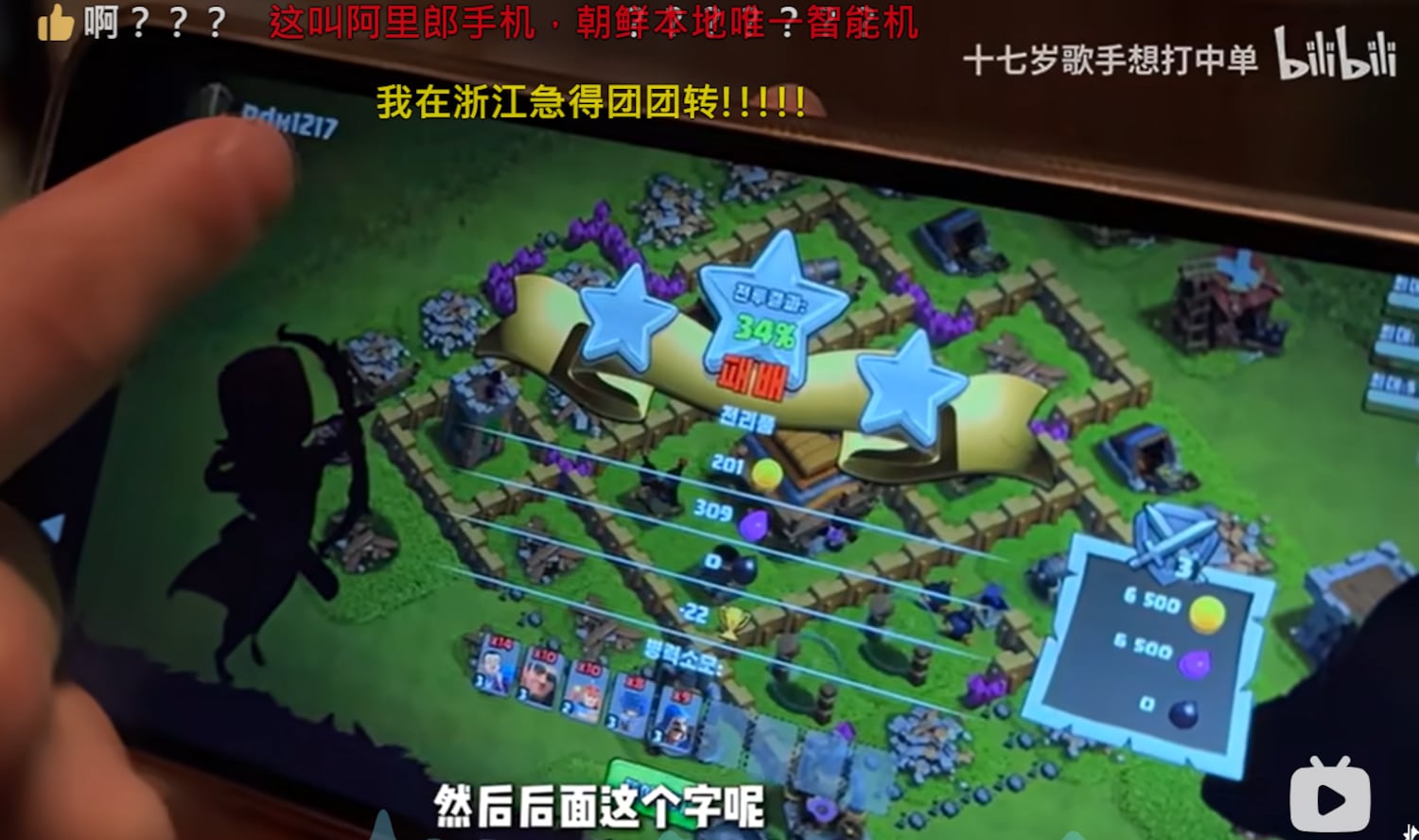
Footage of the bootleg smartphone game, called “Fortress Defense,” leaked on Chinese social media.
Video
Credit: Jamin Anderson for RFA Korean

US Agency for Global Media
News and Information from Around the World
Select a language and narrator voice before playback.
Footage of the bootleg smartphone game, called “Fortress Defense,” leaked on Chinese social media.
Read a version of this story in Korean. A knockoff version of the popular smartphone game Clash of Clans is seemingly a hit with North Korean players, Radio Free Asia has learned. The game, given a name that could be translated as “Fortress Defense,” closely resembles earlier builds of the 2012 smash hit by Finland’s Supercell, which has been downloaded more than 500 million times worldwide. In Clash of Clans, users mine resources, build up their defenses and raid other users’ fortresses. The bootleg version is the latest confirmed example of a North Korean smartphone game that allows online play via the country’s intranet, which is isolated from the rest of the world as a means to prevent residents from accessing information from outside the country. Footage of a North Korean smartphone obtained near the Sino-Korean border in China’s Liaoning province was shared to an account associated with the username Xiao Yang on the Chinese social media platform Xiaohongshu, also known as RedNote, which is said to be similar to the U.S. platforms Instagram or Pinterest. Screen footage leaked When powered on, the phone displayed a logo reading “Hwawon,” a North Korean smartphone manufacturer, meaning that the device cannot connect to the global internet even if taken out of the country. It is restricted to only the North Korean intranet. In the footage, the user opens the Fortress Defense app on the phone and a loading screen appears that closely resembles a former intro screen of Clash of Clans. The logo uses the exact same wood-grain lettering, just with the knockoff title, with the same arrow-ridden shield, but the resemblance does not end there. An old loading screen of Supercell's Clash of Clans, above, compared with the North Korean knockoff, "Fortress Defense," below. (RFA edit/Supercell/小羊朝鲜之旅小小号 via Xiaohongshu) Cartoonish characters – a female archer shooting a bow in the foreground, flanked by her allies, and a male warrior charging at her with an extended sword, with his allies close behind – are posed in the exact same way as the actual Clash of Clans intro screen, though the opposing armies’ clothing, hairstyles and equipment are different. At the bottom of the loading screen, a notice clearly reads: “This product is protected by the software protection law.” The screen soon displays the message “Please check your data connection status,” followed by an error window reading, “Cannot connect to the server. Please check your network status,” before the app shuts down. The notices used North Korean word spellings, which indicate that the bootleg was localized for North Korean users rather than a wholesale ripoff of a version of the game meant for the South Korean market. Chat disabled How the game actually runs inside North Korea was confirmed through footage on another Chinese video platform, Bilibili. Footage filmed by a Chinese content creator who visited North Korea last year shows a woman, believed to be a North Korean resident, playing “Fortress Defense” on a smartphone. At the top of the screen, a counter indicates that there are currently 42,329 players online. This suggests tens of thousands of North Korean players were active when the footage was taken and that there are likely even more users offline. Footage of North Korea's bootleg game "Fortress Defense," showing more than 40,000 users are currently online. (十七岁歌手想打中单 via Bilibili) However, this version of the game does not allow users to type messages to each other. Instead, players are limited to sending each other preset phrases like “Be careful” or “Surrender.” Fortress Defense’s seemingly blatant ripoff of Clash of Clans’ designs and gameplay has sparked considerable interest among users both in South Korea and elsewhere. Clash of Clans fans on the South Korean internet forum DCinside commented that Fortress Defense appeared to be a “recycled older version of the original,” and that it “looks like an earlier build” of the game. Meanwhile, users on the U.S. platform Reddit noted that Fortress Defense “is clearly a private-server game modified from an older system.” They explained that several newer features available in Clash of Clans were not present in the knockoff. RFA attempted to contact Supercell to inquire whether the company was aware of the unauthorized use of its intellectual property inside North Korea, but as of Aug. 5, there was no response. Edited by Eugene Whong.
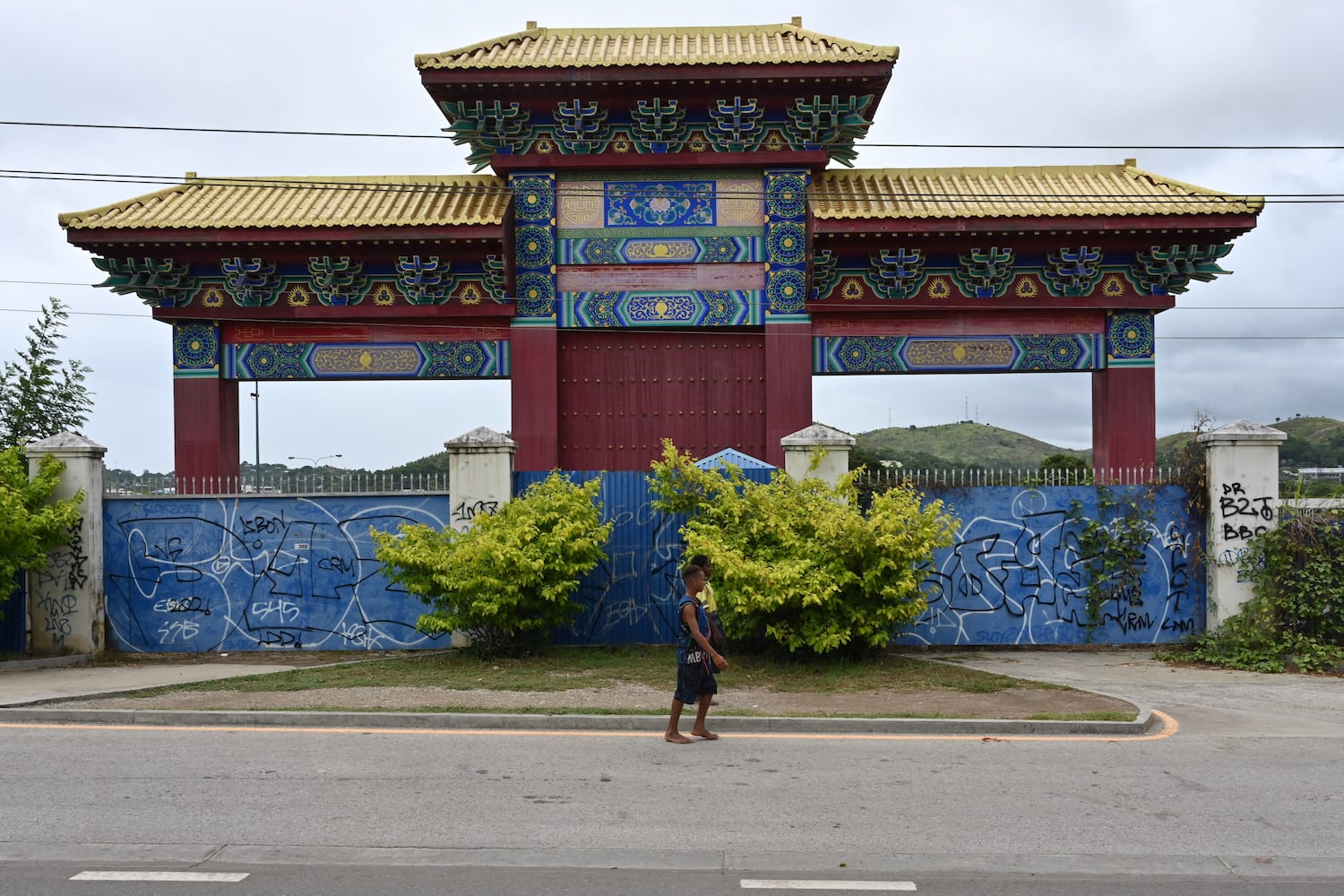
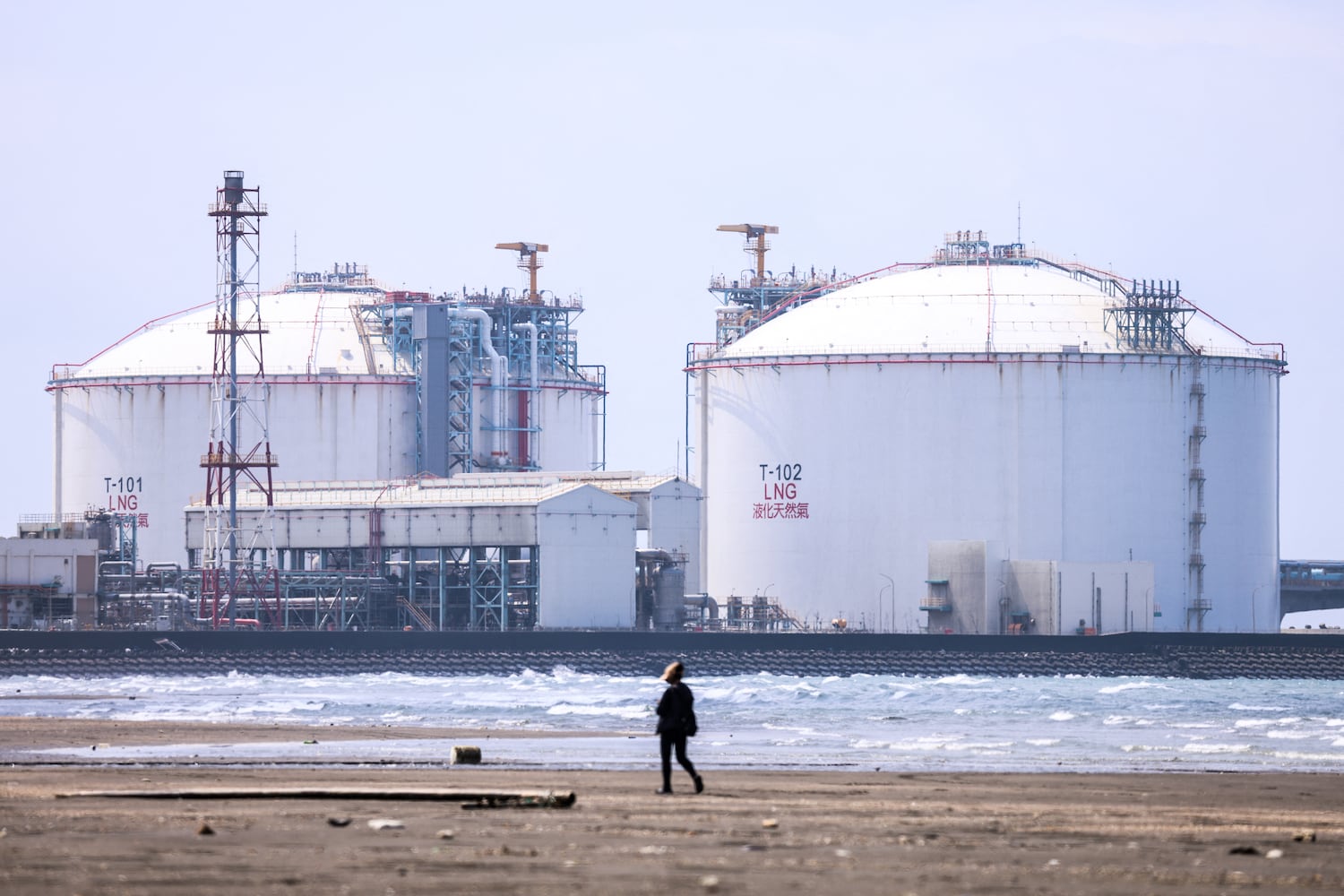
PORT MORESBY, Papua New Guinea – Papua New Guinea’s decision to close Taiwan’s trade office in Port Moresby is puzzling from a diplomatic standpoint, but it signals a coming expansion of its economic relationship with China, experts told Radio Free Asia. Last month, PNG’s Foreign Affairs Minister Justin Tkatchenko announced in an official statement the immediate cessation of operations and the formal closure of the physical presence of the Chinese Taipei Economics Office, citing Port Moresby’s “unwavering commitment to honoring, respecting and upholding Papua New Guinea’s foundational One-China Policy,” which aligns with Beijing’s view, the “One-China Principle,” which states that Taiwan is an inalienable part of its territory. The decision was confusing, Paul Barker, executive director of the PNG Institute of National Affairs, a Port Moresby-based think tank, told RFA. “One really wonders why one would take this action at this point,” he said. “PNG has always stated its position of friends to all and enemies to none and choosing to chart its own path in the region, together with its Pacific partners and its ASEAN colleagues.” Staff from the Taipei Economic and Cultural Office in Papua New Guinea donating rice to the Catholic Archdiocese of Port Moresby, Dec. 20, 2021. (Taipei Economic Office in Papua New Guinea) Barker noted that PNG last year signed a mutual defense treaty with Australia, and has defense arrangements with other regional parties including China, Indonesia and the U.S. “PNG recognized the One China Policy almost immediately after independence, but has also maintained ongoing trade, investment and cultural and related engagement with Taiwan throughout, which seems entirely reasonable, after all so does China with Taiwan, with many aspects of their economies quite connected,” Barker said. One China? PNG’s One-China Policy differs from a policy by the same name held by the United States government. While Port Moresby’s policy recognizes Beijing’s view, the U.S. policy merely acknowledges it and takes no official stance on Taiwan’s sovereignty. Both policies recognize the PRC government as the sole and legal government of China and in practice this has still left room for unofficial relations with Taiwan, and similar arrangements exist in many countries around the world. But unofficial relations with Taipei and Papua New Guinea will soon cease, according to Tkatchenko’s statement. Taiwan’s Ministry of Foreign Affairs strongly protested the closure of its office, vowing to continue to operate it “as normal.” It was not immediately clear to RFA what it would mean to operate the office as normal when it is not recognized by the host government. In the wake of the decision, Taiwan initiated a review of liquefied natural gas imports from PNG and decided to halt spot purchases, which prompted Beijing to announce it would increase its purchases of the commodity from the Pacific Island country. A visitor walks on a beach with the background of Guan-Tang LNG Receiving Terminal, a major liquefied natural gas import facility in Taiwan, March 25, 2026. (I-Hwa Cheng/AFP) Taiwan’s response follows a pattern of cutting ties with governments that downgrade its status, Jonah Bock, assistant director for research at the Alliance Futures Initiative, a Washington-based think tank, told RFA. “It is important for Taiwan to maintain even informal ties with states that do not recognize it,” Bock said. “But it is necessary to send a signal that these actions taken will not go unpunished. The audience is not just Port Moresby but every other country with ties to Taiwan.” Bock said that the closure of Taiwan’s office in PNG was part of a larger campaign to further isolate Taiwan. “In the Pacific Islands only three countries—Palau, the Marshall Islands, and Tuvalu—still recognize Taiwan and none appear poised to flip recognition in the short term,” Bock said. “But recognition is only part of Beijing’s objectives; it also seeks to eliminate Taiwan’s remaining international space. That means going after Taiwan’s continuing relationships—e.g. the closing of the Taipei Trade Office in PNG.” Bock noted how similar measures have been occurring in various areas of the Pacific, with Fiji having closed its office in Taipei in 2017 and having revoked diplomatic privileges to Taiwan’s office in Suva in 2018. Bock further noted that PNG itself closed its trade office in Taipei in 2023, and Nauru directed all government officials to uphold the One-China Principle in all activities last year. “Chinese diplomats in the region are already working to push other countries to end their own ties to Taiwan,” he said. “Short of unification, none of this stops. China will continue to aggressively pursue any action that reduces Taiwan’s international space—its ethos of national rejuvenation relies on unification. It is not an option for China to stop the contest.” Beyond geopolitics and trade Barker explained that the decision would affect more than gas exports and trade. “Educational and cultural links are also strong with scholarships and exchanges, with some useful ongoing development programs in agriculture, and valued investment in PNG,” he said. “The cultural associations between Taiwan and its indigenous population and PNG and the Pacific, of course, go far back, with the dispersion of people from Taiwan and the origins of the Austronesian language stemming from Taiwan going back some 6,000 years.” He said the cultural links to the indigenous people of Taiwan meant that PNG should try to maintain some sort of engagement with Taipei and that this should not undermine any relationship it has with Beijing. In this image released by the Chinese government, PNG Prime Minister James Marape visits Guangdong, China, April 28, 2026. (Chinese government media) But Bock said that money talks, and although the office’s closure does not appear to be in PNG’s economic interest in the short term due to cancelled Taiwanese contracts, the timing suggests that arrangements for expanding the economic relationship with China must be in place. “The move is to curry favor with the PRC and the goal is vast sums of Chinese money,” Bock said. He explained how Prime Minister James Marape visited China in April to explore increasing trade and investment, then in May, the two countries signed an economic framework agreement, and in July the two sides held high-level discussions about the coming PNG-China Business Forum & Trade Expo in Guangzhou. “In the months prior to the closure, China and PNG laid the groundwork for a much larger economic relationship. Closing the office is PNG’s payment to ensure China delivers.” Editing and additional reporting by Eugene Whong in Washington.
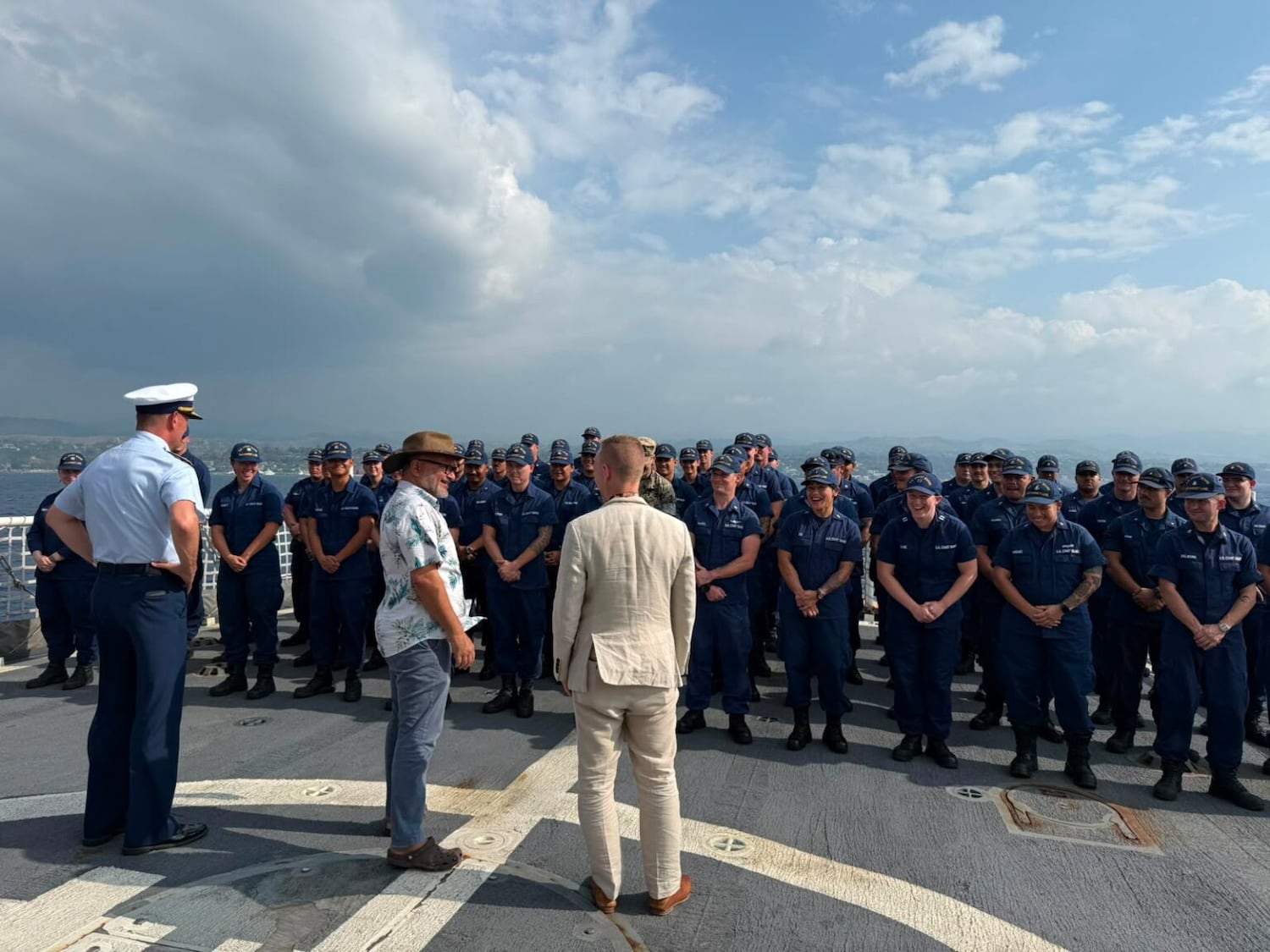
HONIARA – The Solomon Islands’ decision this week to enter into a security pact with the United States while already locked into a security agreement with China is in line with its strict “friend to all and enemy to none” foreign policy, experts told Radio Free Asia. Prime Minister Matthew Wale and U.S. Chargé d’Affaires P. Daniel O’Hara signed the finalized agreement Tuesday aboard the U.S. Coast Guard Cutter Harriet Lane, which had visited Honiara for the occasion. Commonly known as a shiprider agreement, the Agreement Concerning Counter Illicit Transnational Maritime Activity establishes a legal framework allowing Solomon Islands law enforcement officers to be embedded on U.S. Coast Guard vessels. The initiative forms part of Washington’s broader deployment designed to enhance regional stability and counter illegal, unreported, and unregulated fishing across the Pacific. Solomon Islands Prime Minister Matthew Wale (front right) and Chargé d'Affaires P. Daniel O'Hara of the U.S. Embassy sign a shiprider agreement aboard the visiting U.S. Coast Guard Cutter Harriet Lane off the coast of Honiara, July 28, 2026. (Solomon Islands government) The move has drawn sharp criticism from opposition leader and former Prime Minister Manasseh Sogavare, who previously aligned the Pacific nation closer with Beijing by signing a controversial and secretive security agreement with China in 2022. Though it may seem like Honiara is hedging its bets by entering into security deals with both Washington and Beijing, engaging with both geopolitical rivals is standard practice, Alexander L. Vuving of the Hawaii-based Daniel K. Inouye Asia-Pacific Center for Security Studies, told RFA. “This mirrors the actions of many other small countries in Southeast Asia, South Asia, and Oceania, signaling that the Solomon Islands cares about its autonomy and wishes to avoid taking sides,” he said. He also dispelled concerns regarding tensions with Beijing over Taiwan, stating, “The shiprider agreement focuses purely on maritime security within the Solomon Islands’ Exclusive Economic Zone, which does not conflict with or affect the One China Policy.” Maintaining neutrality The signing occurred a day after the prime minister concluded diplomatic visits to the United States and Japan. Upon his arrival at Honiara International Airport on Monday, Wale emphasized to reporters that the Solomon Islands has no desire to become a proxy battleground for larger powers. “We are not in a geopolitical game. We are not interested! Let the big boys sort out the big stuff,” he said. He stated that the country’s foreign policy is meaningless unless backed by reliable development partners, asserting that the nation intends to cooperate with all major powers while letting larger global players manage their own geopolitical rivalries. He acknowledged China as a critical trading and development ally, affirming that his administration would continue to work closely with Beijing to protect national interests and improve local livelihoods. Youth walk past an under-construction medical center financed by the Chinese government, in Honiara, Solomon Islands, April 21, 2024. (Saeed Khan/AFP) On a previous diplomatic visit last month to Canberra, Wale and Australian Prime Minister Anthony Albanese signed a memorandum of understanding concerning security and police cooperation, and agreed to begin negotiations on a treaty that would redefine the bilateral relationship. “Regional powers have largely viewed the recent security agreements with Australia and the US as a positive pivot or rebalance of the country’s foreign policy,” Dr. Vuving said. But he warned that ultimately the ability to maintain more or less neutral stance depends on the domestic political situation. “The long-term sustainability of this delicate approach requires a parallel balance in domestic politics,” he said. “Any lack of commitment to autonomy could result in increased pressure from rivaling great powers to pick a side.” That’s politics Though Wale’s government believes the shiprider agreement to be beneficial, the opposition has strongly criticized the deal. Manasseh Sogavare, a former four-term Prime Minister who critics have said is very pro-China and who most recently led the country between 2019 and 2024, warned that welcoming the U.S. military could compromise the nation’s sovereignty. During Sogavare’s most recent term, he orchestrated a dramatic geopolitical shift in the South Pacific by aligning the Solomon Islands with China and severing diplomatic ties with Taiwan. U.S. officials quickly rejected Sogavare’s criticisms emphasizing that the arrangement is built entirely on mutual respect for local sovereignty. O’Hara clarified that the agreement actively reinforces local authority by providing American operational capability while keeping all law enforcement decisions under domestic control. “This agreement is about mutual benefit,” O’Hara stated after the signing. “Your officers will enforce your own laws in your own waters. You decide which vessels to investigate. You determine the violations. You set the penalties.” Entering into international agreements with a mostly executive approach based on the political leanings of whomever holds the office of the prime minister has left some everyday citizens frustrated by a lack of transparency. “Did Wale consider Solomon Islanders before signing any foreign agreements?” Brian Wanealafa, a Solomon Islands resident, told RFA. “He should make consultations first, or even bring that before parliament.” Wanealafa said the criticism extended beyond just Wale. “The same is with Sogavare, when he signed the security pact with China,” he said, referring to the 2022 agreement. “They should think of the citizens and do nationwide consultations, or bring to Parliament and dissect the agreements openly for people to understand.” Legal and Sovereign Realities Criticism that the agreement compromises the Solomon Islands’ sovereignty is invalid because it conflates political concerns with legal principles, Joseph Foukona, a history professor at the University of Hawaii at Manoa, who hails from the Solomon Islands, told RFA. Foukona described the sovereignty argument as “twisted,” saying it centers more on “political concerns than legal ones.” “Signing the Shiprider Agreement without parliamentary scrutiny is a non-issue, as it falls well within the executive government’s powers,” he said. “Previous administrations have similarly bypassed parliamentary oversight for memorandums of understanding and treaties.” He emphasized that the US partnership perfectly aligns with international environmental and maritime treaties the Solomon Islands has already signed. “These international treaties require a maritime enforcement mechanism to be effective,” Foukona said. “The Shiprider Agreement simply provides the platforms – U.S. Coast Guard vessels – for Solomon Islands law enforcement officers to enforce their own maritime laws and treaty provisions.” Ultimately, under the pact, local officers will enforce their own laws in their own territorial waters, retaining final and absolute authority over all maritime policing decisions, he said. Edited by Eugene Whong.
Taiwan has halted spot purchases of natural gas from Papua New Guinea as a response to Port Moresby ordering the closure of Taipei’s trade office in the South Pacific country. The decision followed Taipei’s review on imports originating from PNG of liquefied natural gas, or LNG, and the move amounts to a warning that countries with ties to Taiwan could face consequences rather than full-scale economic coercion, experts told Radio Free Asia. “It functions as immediate diplomatic signaling, but also sits within an emerging, if still constrained, strategic adjustment,”Jozef Huljak, a PhD candidate in political science at Constantine the Philosopher University in Slovakia whose research examines Taiwan’s cultural and public diplomacy, told RFA when the decision was in its review stage. Huljak explained the immediate message was that Papua New Guinea’s decision would not be “cost-free,” while also signaling to other governments that downgrading unofficial ties with Taiwan could carry consequences. “The LNG review is primarily a signal, but one embedded in a gradual shift toward more calibrated responses as Taiwan’s informal diplomacy comes under sustained pressure,” he said. Downgrading ties Papua New Guinea on July 15 announced that it would close Taiwan’s representative office in Port Moresby, saying that the move was meant to align with its “One-China policy” and to deepen trust and economic ties with Beijing. Port Moresby has never recognized Taiwan since gaining independence in 1975 and establishing relations with China the following year. The Taiwan trade office, which opened in 1990, served as Taipei’s de facto diplomatic mission while facilitating trade and investment. Taipei blamed the decision on Chinese political and economic pressure, while the United States expressed concern. Beijing, meanwhile, praised the move. Two days after the announcement, Taiwan’s Foreign Minister Lin Chia-lung said the country was reviewing its broader economic exchanges with Papua New Guinea, including LNG imports of about 1.2 million metric tons a year – roughly one-third of Papua New Guinea’s LNG exports – while stressing that Taipei’s agricultural and fisheries cooperation had also supported local development. On Tuesday, Lin said that the country would stop spot purchases of LNG from PNG, AFP reported. Spot purchases are one-off arrangements to cover immediate needs rather than long term agreements for periodic deliveries. The ExxonMobil PNG Limited operated Liquefied Natural Gas (LNG) plant at Caution Bay, located on the outskirts of Port Moresby, Papua New Guinea, Nov 19, 2018. (David Gray/Reuters) Liquefied natural gas, or LNG, is Papua New Guinea’s largest export commodity, accounting for roughly half of its overall exports. While Taiwan is the destination for about a third of PNG’s LNG exports, that only accounts for about 8% of Taiwan’s imports of LNG. Stopping the spot purchases is somewhat of a departure from Taipei’s previous course. Taiwan has traditionally sought to distinguish itself from China by presenting itself as a reliable partner that does not use trade or investment as political leverage. Beijing, meanwhile, has repeatedly been accused by Western governments and observers of employing economic coercion against countries that challenge its interests. The stoppage of LNG spot purchases, however, is not the first such move by Taiwan – it also recently removed Cambodia from visa facilitation programs after Phnom Penh publicly backed Beijing’s position on Taiwan. Together, these moves suggest Taipei is becoming more willing to attach consequences to governments that reduce cooperation with Taiwan, even if the measures stop short of outright retaliation, Huljak said. Tit for tat? Still, analysts cautioned that Taiwan’s options remain constrained. “I think ... comments made by Foreign Minister Lin still should be primarily viewed as first and foremost diplomatic signaling,” William Yang, a Northeast Asia analyst at the Belgium-based International Crisis Group, told RFA, also while the decision was still in the review stage. “It’s a warning or it’s a reminder, rather than Taiwan already embracing the idea about weaponizing its existing trade link and relationship with other countries to counter their willingness to ... give in to Chinese pressure,” he said. Yang said Taiwan was also likely examining its energy relationship with Papua New Guinea not just as a form of leverage, but also as a legitimate precaution due to its heavy reliance on LNG. Taiwan imports about 95% of its energy, and if Beijing is able to influence countries supplying critical resources, “Taiwan will have to also take a precautionary look and examination of its existing trade relationship with a particular country that has shown the willingness to actually bow to China’s pressure,” he said. Newly constructed worker's accommodation can be seen in front of the ExxonMobil PNG Limited operated Liquefied Natural Gas (LNG) plant at Caution Bay, located on the outskirts of Port Moresby, Papua New Guinea, Nov. 19, 2018. (David Gray/Reuters) Despite PNG accounting for less than one-tenth of Taiwan’s LNG imports, it provides an important source of supply diversification at a time when natural gas generates nearly half of Taiwan’s electricity following the shutdown of its last nuclear reactor in 2025, according to Huljak. “A full break would therefore carry higher costs for Taiwan’s energy security than for PNG’s export revenues,” Huljak said. “The review is real, but escalation is structurally constrained.” Message to other partners The episode nevertheless carries broader implications beyond Papua New Guinea, analysts told RFA. The impending trade office closure suggests Beijing is increasingly targeting Taiwan’s informal international presence rather than focusing only on the island’s dwindling group of formal diplomatic allies, Huljak said. “If left unanswered, Papua New Guinea risks becoming a template,” he said. “Governments could align with Beijing, accept economic incentives, and assume that Taiwan lacks the capacity to respond.” Taiwan’s objective, he said, is to challenge that assumption by demonstrating that even unofficial relationships have value and that ending them may carry opportunity costs. Meanwhile, Yang believes any decision by Taiwan to reduce LNG imports from Papua New Guinea would resonate beyond the immediate dispute. “If Taipei does follow through on ... reducing or ending its LNG trade with PNG, it obviously will be sending a signal to the rest of the Pacific countries,” he said. “It would not simply just sit idly and allow these countries’ decisions to further shrink Taiwan’s international diplomatic space,” Yang added, describing it as a demonstration of Taipei’s resolve to protect its interests and sovereignty. Edited by Eugene Whong.
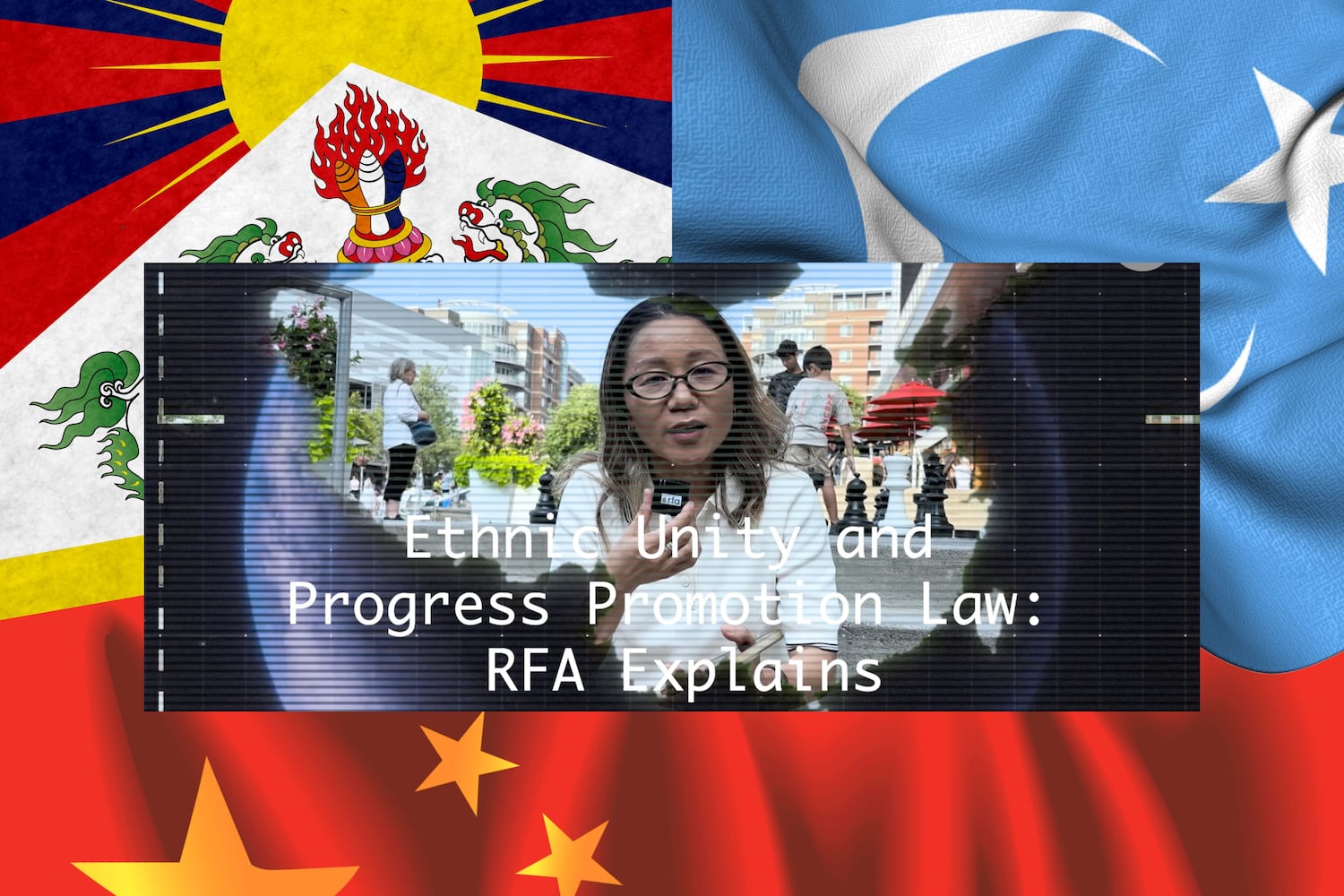
Updated July 27, 2026 at 12:45 ET It’s called the Law on Promoting Ethnic Unity and Progress—China’s newest law under President Xi Jinping, passed on March 12, 2026, and in effect since July 1, 2026. The law contains 65 articles, many of which have raised concerns among Tibetans and rights groups. In this explainer, we focus on four key areas of the law that have drawn the most attention: identity, language, religion, and its reach beyond China’s borders. First, it seeks to reshape how ethnic identity is understood in China . The law calls on Tibetans, Uyghurs, Mongolians, and other ethnic groups to build what it describes as “a strong sense of community for the Chinese nation,” placing a shared national identity at the center of ethnic policy. Second, it changes the legal framework around language . Under Article 15, Mandarin is given priority in education and government affairs. While the law says minority languages are “respected and protected,” it also states that when Mandarin and minority languages are used together, Mandarin should take priority in position and order. Third, it expands state oversight of religion . Article 46 requires religious groups, religious schools, and places of worship to promote a sense of community for the Chinese nation, follow the policy of “ Sinicization of religion ,” and guide religious activities to adapt to socialist society. Critics say this could further increase state control over religious practices, including Tibetan Buddhism. Fourth, and one of the most internationally scrutinized provisions, is Article 63, which extends the law’s reach beyond China’s borders . It states that anyone living outside China could face legal consequences if Beijing determines their actions undermine “ethnic unity” or create “ethnic division.” Beijing frames all of this as protection and development , equal rights for all ethnic groups, and continued investment in poorer regions. Officials point to new schools, infrastructure, and job programs in places like Tibet and Xinjiang as evidence of that commitment. But the law’s reach goes well beyond schools and language. It also links ethnic affairs directly to national security, calling for action against what it defines as separatism, extremism, and terrorism, both inside China and abroad. Critics say the law gives legal backing to policies that were already being implemented in minority regions. They argue that putting these policies into law could allow authorities to enforce them more broadly and with fewer limits. In Xinjiang, this builds on years of mass detention documented in Uyghur communities. In Inner Mongolia, a preview came in 2020, when new Mandarin-language mandates in schools triggered mass protests and a purge of local officials. In Tibet, it builds on existing restrictions around religious teaching and Mandarin-medium education. The concern isn’t limited to human rights groups. In June, the United Nations human rights chief, Volker Türk, called on China to repeal the law, warning it risks violating multiple international treaties China has ratified, and could deepen restrictions on language, religion, culture, and expression for ethnic minorities. Whatever this law is ultimately called—unity or assimilation—it’s now in effect. And its impact is likely to be felt for years to come, in Tibet, Xinjiang, Inner Mongolia, and beyond. RFA Tibetan spoke with regional experts, rights advocates, and a Chinese government spokesperson for their comments on the new law: Frank Lehberger, sinologist “This is however not a recent reversal of policies, but a concretization of legal, ideological and brutally repressive ethnic policy.” Brahma Chellaney, geostrategist “Tibet may see its demographic balance shift in such a way as to make the region indistinguishable from provinces in the Chinese heartland.” “The 2026 law provides the legal framework for breaking up minority-heavy areas by moving Han Chinese into them while relocating minorities into the Chinese interior for ‘labor programs.’” “The likely long-term impact will be the erosion of distinct ethnic identities in favor of a singular Chinese national identity, with Mandarin the sole language of education.” James Leibold, La Trobe University “The deeper impact may be slower and more bureaucratic: minority identity becomes something to be managed, curated and disciplined by the party-state. That is how assimilation often works, not with one grand announcement, but through schools, textbooks, cadres, museums, slogans and forms.” “Truly, the paperwork is where empires go to pretend they are being reasonable. Difference is tolerated rhetorically, but the political direction is toward sameness.” Bhuchung Tsering, International Campaign for Tibet “This law would be the codification of the change in the bilingual education system in the Tibetan areas ... Tibetan schools have at various times been implementing Model One, which means Tibetan language is the medium of instruction. Now, through the imposition of Chinese on the Tibetan people, and with Mandarin becoming the medium of instruction, China is changing the bilingual education system in the Tibetan area, and that will have an impact on the Tibetan people.” Tsemoling Penpa, former political prisoner “The intention behind China’s new Ethnic Unity Law... is the complete erasure of Tibet and Tibetan identity. It’s not only about religion or culture—it is about erasing Tibet as a whole.” Liu Chang, spokesperson, Chinese Embassy in Washington “China is a multi-ethnic country where various ethnic groups are all equal and united in a harmonious relationship of mutual assistance. Article 63 targets unlawful acts that undermine ethnic unity and incite separatism, with the fundamental aim of safeguarding ethnic harmony, social stability, and national security.” “We urge relevant parties to respect the basic facts, stop making unwarranted criticisms and irresponsible remarks on China’s ethnic policies and rule of law, and cease using so-called ethnic issues as a pretext to interfere in China’s internal affairs.” Edited for Tibetan by Tawang and for RFA English by Charlie Dharapak. Updated to condense responses for clarity.
Experts say music video aims to humanize China’s coast guard while reflecting Beijing’s stance in the disputed sea.
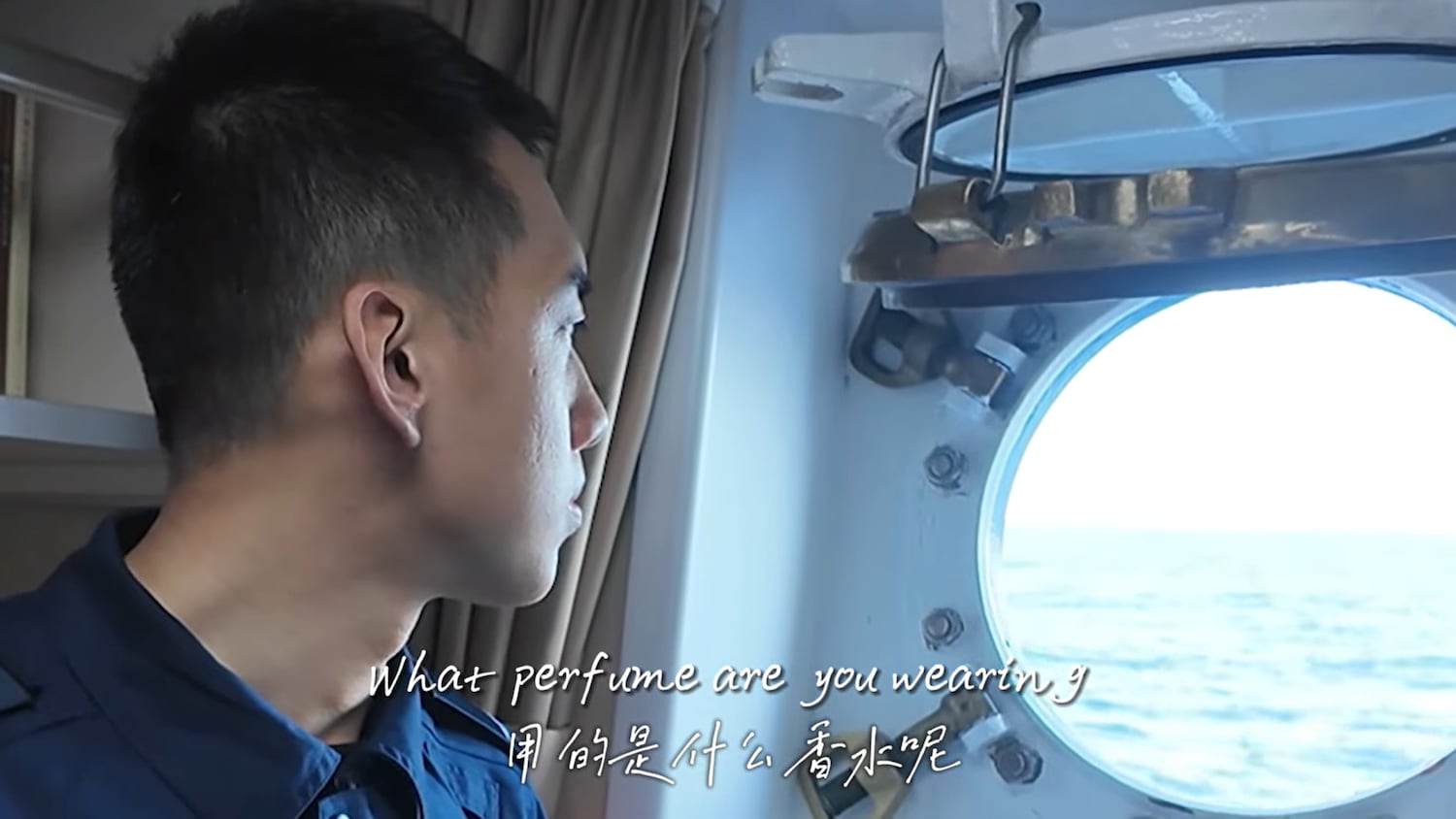
UPDATED on July 22, 2026 at 10:16 p.m. ET The video opens with an aerial shot of a lone China Coast Guard ship at sea on a calm day, as soft, whimsical music carries us into China’s latest propaganda song. “Azure sky, crystal sea, chasing gulls, blazing sun, patrolling the South China Sea, guarding endless loneliness, endless vastness, and guarding this sea, this peace and harmony.” The lyrics of the first verse introduce the setting – this is a song about an enlisted member of the coast guard stationed on the disputed sea, thinking longingly about someone he loves back home. In later verses, he asks her what color the clouds are where she is, what perfume she’s wearing, and if she’s drinking coffee or tea, because he’d like a taste too. The song, “I Miss You on the South China Sea,” is Beijing’s latest attempt to use popular culture to shape international perceptions of one of Asia’s most contentious maritime disputes, analysts told Radio Free Asia. Analysts say a new South China Sea pop song is propaganda (RFA Video) The English version of the music video was released this month by Chinese state media to coincide with the 10th anniversary of the 2016 international arbitral tribunal ruling that rejected the legal basis of Beijing’s sweeping claims over most of the disputed waters. A Mandarin version debuted about six months earlier during the Lantern Festival, a Chinese cultural event that marks the end of Lunar New Year celebrations and the coming of spring. Though the English version is seemingly intended to appeal to an international audience, the analysts questioned whether this campaign is likely to resonate beyond viewers and listeners already sympathetic to China. “China’s state media spends little time actually thinking about how the message will be received elsewhere,” Ed Moon, an independent cross-Strait analyst and founder of intelligence site Strait Signal, told RFA. “Its major focus is on ensuring that the overall message correctly aligns with the official narrative.” At one point, the singer uses a quantum physics term romantically, telling his beloved that he would cross time and space to prove with her “what quantum entanglement is.” But despite the apparent awkwardness of the English lyrics, the song attempts to portray China Coast Guard personnel as ordinary people with very real feelings of longing for home and those they love, while their duties have called them far away to the remoteness of the open sea. Controlling the narrative The video reflects a broader effort by Beijing to complement official statements with emotionally driven storytelling, as China increasingly seeks to communicate its positions through documentaries, influencers, short videos and other forms of popular media. “China wants to project its presence in the South China Sea as peaceful, benign and wholly normal. The focus on the human aspect of the coast guard crew members fits this pattern,” Moon said, adding that Beijing’s state media is primarily concerned with ensuring content aligns with the Communist Party’s official narrative rather than persuading foreign audiences. A China Coast Guard ship monitors a Philippine fisherman aboard his wooden boat in the disputed South China Sea, May 16, 2024. (Ted Aljibe/AFP) Within China’s political system, he said, Beijing’s sovereignty claims are treated as historically and factually self-evident, leaving little perceived need to explain them to overseas audiences. Instead, Moon said, China has increasingly outsourced the task of “explaining” the country to foreign employees working within its media system and to overseas influencers who produce favorable content about China. As a result, English-language state media has become less important than maintaining consistency with Beijing’s messaging. He also noted a growing emphasis on producing content in both Chinese and English, describing it as evidence of tighter coordination across state media outlets and a renewed focus on overseas Chinese communities, which Beijing increasingly sees as receptive audiences. An image from the "I Miss You on the South China Sea" music video produced by the Chinese government. (China Military Bugle via YouTube) The song represents an effort to use culture as a political tool while softening the image of the China Coast Guard, Jason Ng Sze Chieh, a lecturer at INTI International College Subang in Malaysia, told RFA. “An attempt to instrumentalize culture and popular media, asserting China’s authority to patrol and ‘protect’ the South China Sea,” Ng said. “The music video is the other track: a targeted production built specifically to sell a peaceful image of China.” Defending Beijing’s interests Ng said the song consciously rebrands the China Coast Guard as “a benign force rather than ‘Wolf Warrior,’” using themes of intimacy and personal sacrifice while leaving the underlying political message unchanged. “The message underneath doesn’t change – China is defending its interests, and nothing else,” he said. Ng contrasted the music video with what he described as another strand of Beijing’s influence strategy – embracing successful cultural works that were not originally created by the state but later align with its messaging. A Chinese Coast Guard ship fires a water cannon at Unaizah May 4, a Philippine Navy-chartered vessel, conducting a resupply mission to troops stationed at Second Thomas Shoal, on March 5, 2024 in the South China Sea. (Ezra Acayan/Getty Images) He said Beijing increasingly pursues “two tracks,” continuing to produce explicitly patriotic material while also co-opting independently produced content that promotes a favorable image of China, particularly among overseas Chinese communities. “The music video feels like artificial intelligence-generated slop, rendered in the soothing style of Chinese pop and designed to sell the world on China’s ‘peaceful’ intentions,” Ng said, adding that the production’s visuals and even the singer’s voice appeared artificial. China has increasingly sought to present its coast guard as a professional force maintaining order in what it considers its own waters, even as confrontations with Philippine and Vietnamese vessels have intensified in recent years. Beijing says its actions are lawful and necessary to safeguard its sovereignty, while rival claimants accuse it of intimidation and coercion. The 2016 ruling by an international tribunal in The Hague found that China’s expansive “nine-dash line” claims had no legal basis under international law. China rejected the ruling and continues to assert sovereignty over most of the South China Sea, where competing claims by the Philippines, Vietnam, Malaysia, Brunei and Taiwan have made the waterway one of the region’s most volatile flashpoints. Edited by Eugene Whong. Update specifies that the Mandarin version preceded the English version by roughly six months.
Aung San Suu Kyi’s son demands proof of mother’s life, urging world leaders to prioritize rights over diplomacy.
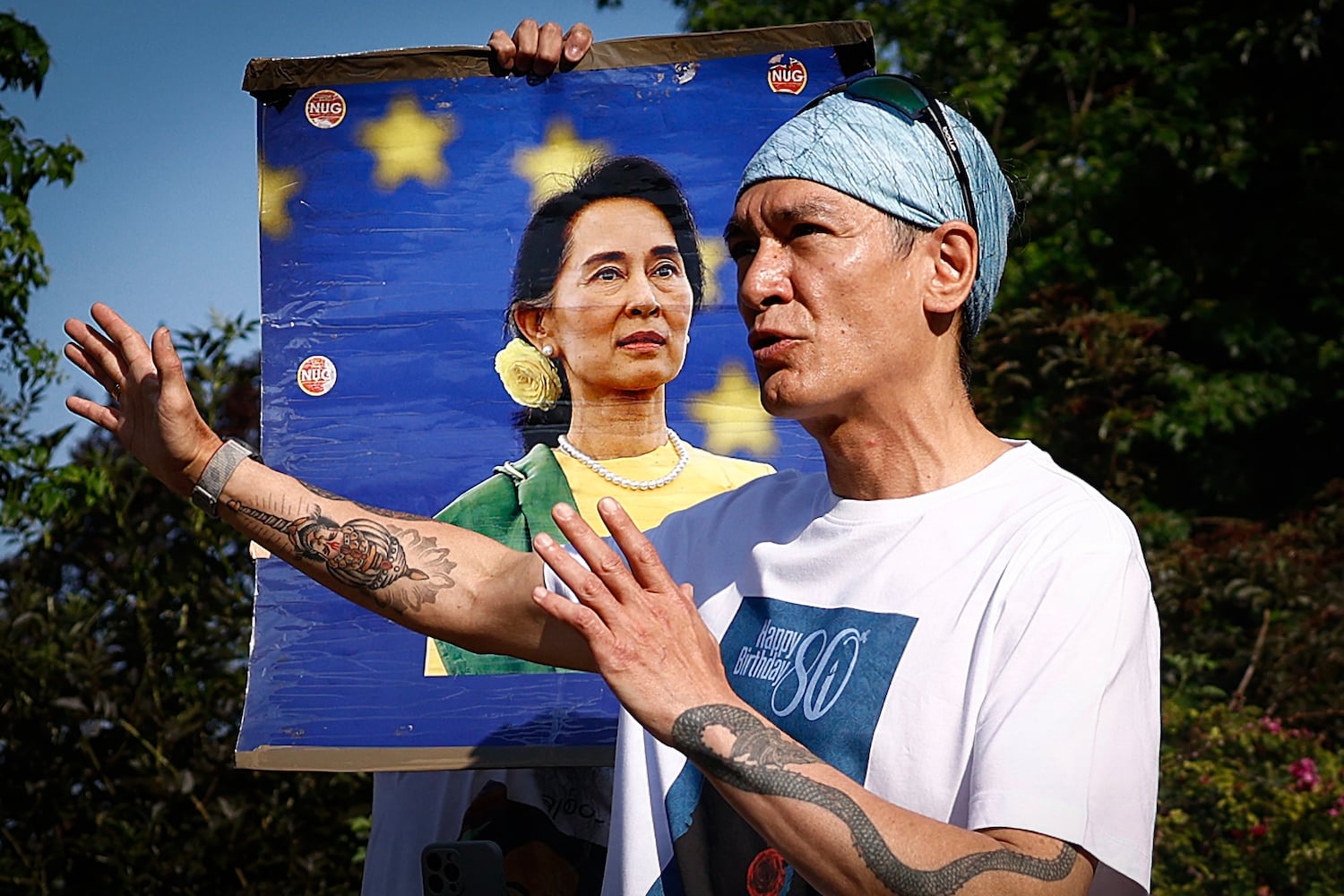
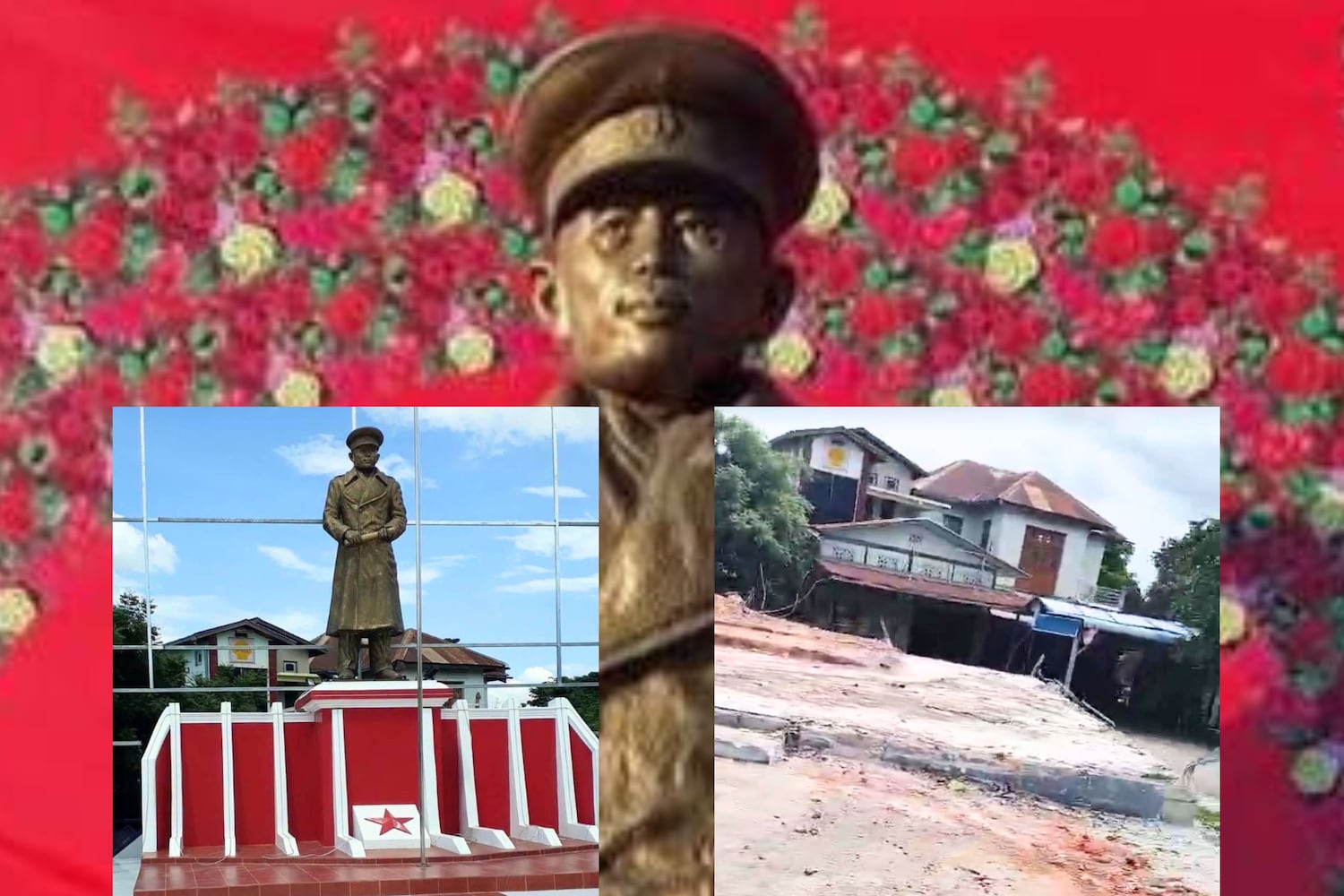
Read RFA coverage of this story in Burmese In the months following the 2021 Myanmar military coup , ASEAN banned the junta from attending its annual summit. Earlier this year, junta chief Min Aung Hlaing oversaw staged, multi-phased elections which resulted in his being named President in April. On July 12-13, ASEAN foreign ministers held their first direct, in-person informal meeting with Myanmar’s foreign minister in Bangkok. Kim Aris on ASEAN and Myanmar Kim Aris, son of Aung San Suu Kyi, spoke to RFA on July 20 about ASEAN’s recent engagement with Myanmar, and about his mother who, according to the military-backed government, was transferred from prison to house arrest in April. The interview has been edited for length: RFA: ASEAN recently met with Myanmar’s foreign minister who told them that Aung San Suu Kyi is in good health even though she’s still being detained. He also referred to her as “a sister,” telling them that the military authorities would take care of her. What were your reactions to those remarks? Kim Aris: I was shocked. If that’s how they treat their sister, I don’t want to know how they treat other people. They still have not allowed me to have any contact with her, and have been denied her basic human rights. And while they say they’re looking after her, they’re not providing any evidence to support that fact. And they’re saying that no one’s allowed to talk to her or see her until after she has finished serving her sentence. So she would be over 100 years old by that point. I don’t know where she’s been held or how she is. And she’s over 81 years old now with ongoing health problems . And the fact that she’s been held in probably very bad conditions in a prison in Naypyidaw for the last five years. That makes me extremely concerned. RFA: Have you heard any updates about your mother recently? Kim Aris: No, nothing. The last I heard was when there was some news saying that she had been moved to house arrest. But again, there was no evidence to support that. This undated photo from the Myanmar Military Information Team released on April 30, 2026 shows Aung San Suu Kyi talking in an undisclosed location. (Myanmar Military via AFP) What are you hoping for at this point? Half of the international community have been under the wrong idea for the last five years. They have thought that she’s been under house arrest. Actually, she’s been in prison all of this time. But the military spread rumors each year saying that she’s been moved to house arrest and the world listens to these rumors and unfortunately they fall for it all the time. So once again they say that she’s been moved to house arrest without providing any evidence. All I can ask for is that the international community and the world leaders follow President Macron of France’s example and make their position very clear and call out for proof that my mother is alive and for her to have her basic human rights restored. She’s been sentenced to however many years it is, I don’t know, 25 or 30 years in prison and these charges against her are completely false. In the first place, she should never have been in prison. So I’m calling for her to be freed. Following the recent informal meeting, are you hopeful that it could lead to any meaningful changes? What kind of progress would you like to see about your mother and Myanmar people? I hope that there’ll be no further engagement until certain conditions are met. And that includes the five point consensus that is abided by. And that also includes that my mother is freed along with all the other political prisoners. I can only hope that people will not be engaging with the military too publicly. Obviously I realize they need to talk to them, negotiations need to happen, but this should not happen publicly because that only legitimizes the regime. East Timor's Foreign Minister Bendito dos Santos Freitas, Vietnam's Foreign Minister Le Hoai Trung, Malaysia's Chief Secretary Shamsul Azri Abu Bakar, Thailand's Foreign Minister Sihasak Phuangketkeow, Philippines' Foreign Minister Tess Lazaro, Singapore's Foreign Minister Vivian Balakrishnan, Brunei's Second Minister of Foreign Affairs Erywan Yusof, Indonesia's Foreign Minister Sugiono, Laos' Foreign Minister Thongsavanh Phomvihane and Myanmar's Foreign Minister Tin Maung Swe pose for a photo during an informal meeting with ASEAN Foreign Ministers in Bangkok, July 12, 2026. (Thailand Ministry of Foreign Affairs via Reuters) ASEAN is still engaging with the military-backed government, even though the Five-Point Consensus hasn’t been implemented. What do you think of ASEAN’s continued engagement under these circumstances? Well, obviously they still have to talk. But again, I’ll say it again, it doesn’t need to be public. It should be done behind closed doors and done in such a way that it does not legitimize the regime. Do you think this approach is helping to resolve the Myanmar crisis? It’s hard to say. We’ll have to see if there’s, you know, actual tangible results in times to come. Let us see. But that would include that the military stops bombing the people and frees all the political prisoners. Those are real tangible results, otherwise it’s pretty meaningless. A statue of General Aung San in Ye-U, Sagaing region, Myanmar in undated photos and on June 28, 2026, bottom right, after it was removed the night before. (Myint Htwe via Facebook) In your Martyrs’ Day video message, you spoke about the actions against statues of your grandfather , General Aung San, across the country. The military government said it was not destroying the statues but reexamining and correcting them under historic monument laws. What is your response to that explanation? I don’t see why they needed to go and tear down the portrait of my grandfather outside 54 University Ave. That wasn’t a statue anyway. And that just goes to show that it’s not just about things. They’re correcting whatever it is. I think that’s laughable. I know that last year also there were statues torn down and yet Min Aung Hlaing still visited the museum of my grandfather’s house. It’s a very confusing message that they’re sending there. My grandfather stood up against fascism and colonialism and he would be appalled to see what the military are doing to the country now. Even though he is the founder of this military, he would not like the direction they’ve taken. He was never about centralized power, he was about federal power and it didn’t matter where the leader of the country came from so long as he was a good leader. That’s what he believed. Kim Aris, the son of Aung San Suu Kyi, takes part in a protest denouncing an upcoming election led by the military junta and demanding the immediate release of Myanmar's detained former leader Aung San Suu Kyi and all political prisoners, in Tokyo, Dec. 14, 2025. (Issei Kato/Reuters) You have been leading the Proof of Life Campaign to draw global attention to your mother’s situation. What kind of support have you received from governments and the international community so far? Lots of governments and communities have joined this call and it has been very touching to see everybody join me in this. But that’s been encouraging, it hasn’t actually achieved what I want and that I still do not have any contact with Maymay and I still have no proof that she is alive. Nothing that the military have said or done reassures me in any way because they’re still just saying that she’s fine without providing any evidence. So, I’m extremely grateful for everybody who joined this call. I can only ask them to continue to call and to do more in order to actually get results because words only get so far. We have to take concrete actions and for ASEAN, that would include actually stopping the illegal flow of weaponry going across their borders. Do you think the campaign is putting significant pressure on Myanmar’s military regime? I think it is having an effect, so I shall keep going. Kim Aris walks Taichito, Aung San Suu Kyi’s dog, in Myanmar’s Mount Popa Botanical Garden and Museum in Kyaukpadung township, near Bagan, July 6, 2011. (Soe Teya Tun/Reuters) Taichito passed away last month. Could you share a little about the bond between your mother and Taichitoe? Maymay was very fond of Taichito and Taichito was very protective of Maymay. He didn’t like it when people took up too much of her time and he would let them know. So he was actually part of the fighting dog in his blood. So he could be quite bad tempered if he wasn’t happy. But Maymay was able to train him so that he wasn’t too bad. I think it’s the best gift I could have given her. And he was with her for over 10 years before she was put in prison. I was just very sad that he couldn’t be with her for the last five years. Have you thought about what you’d like to do with your mother once she’s free? Just normal family things. I’d like to cook her a meal and go for a walk with her. And, have her spend time with her grandchildren. I’m sure she’s missing us as much as we’re missing her. And I can only think that in time, we will get to see her. Edited by Charlie Dharapak.
Satellite imagery shows significant progress on the bridge that experts say will transform Sino-North Korean trade.
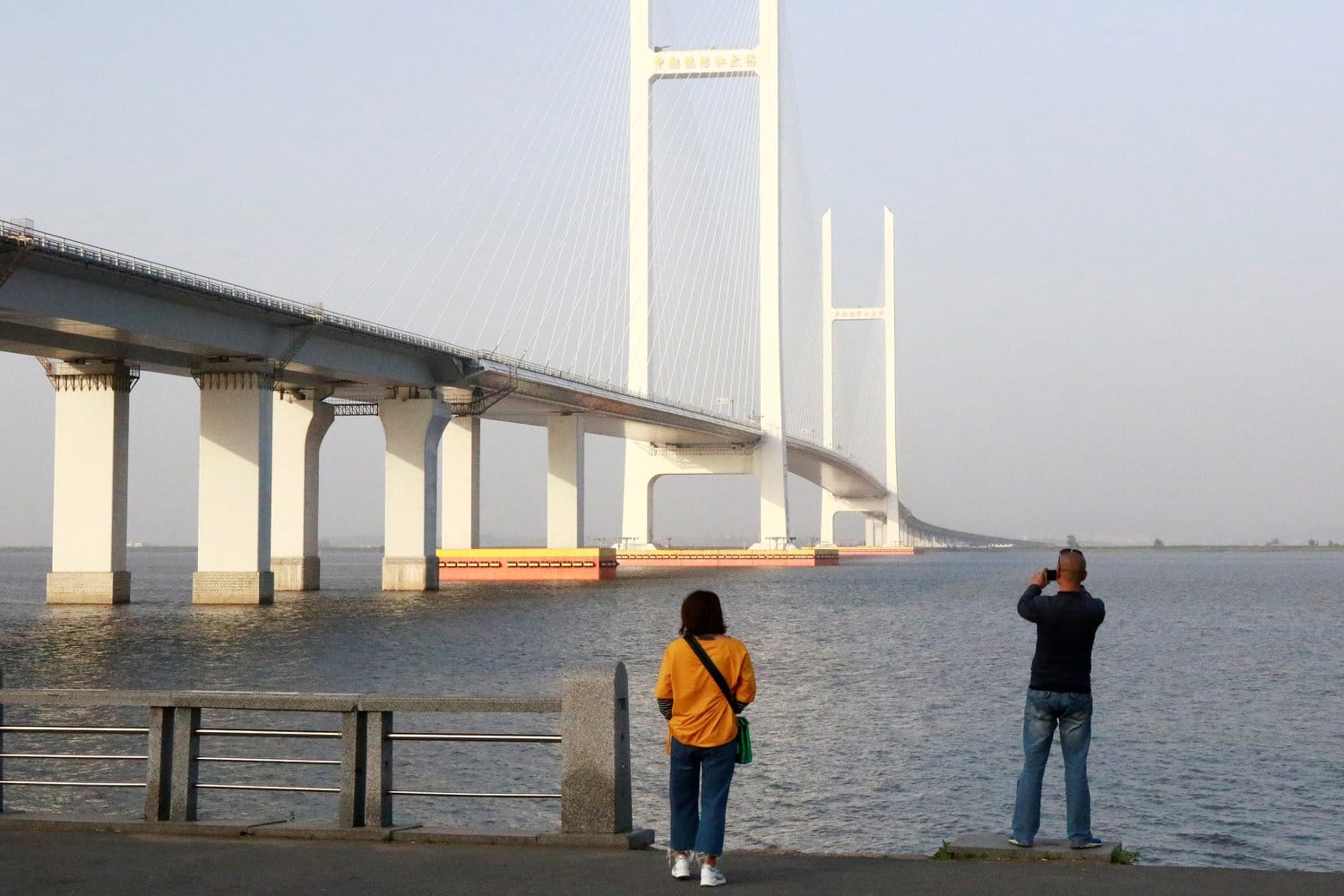
North Korea is close to completing a long-delayed new bridge to China, satellite imagery analyzed by Radio Free Asia shows. Experts said that once the new bridge connecting Dandong in China with Sinuiju in North Korea is complete, trade volume will more than double, relieving pressure on the aging Sino-Korean Friendship Bridge – the only other connection between the two cities – considered the main artery between the two countries. Pyongyang and Beijing completed the structure of the New Yalu River Bridge in 2014, with the Chinese government footing the bill, but since then it has remained unopened because the two sides could not come to an agreement on financing construction on infrastructure facilities on North Korea’s end. But construction resumed in January 2025 after Chinese firms agreed to invest, and if all goes according to plan, the new bridge could go into service as early as autumn, Bruce Songhak Chung, a senior researcher at the Seoul-based Korea Institute for Security Strategy, told RFA. “Chinese traders involved in cross-border commerce said discussions on an opening ceremony could be held once construction on the North Korean side is completed,” Park Jongchol, a professor at Gyeongsang National University in South Korea said. “On the Chinese side, there were a few predicted dates being discussed — such as October 3, the date the two countries established diplomatic relations — though these have not been confirmed by either Beijing or Pyongyang.” Even if that prediction ends up being incorrect, Chung said he expects the bridge to open this year based on his assessment of the imagery. Satellite imagery shows rapid progress at North Korea's customs complex connected to the New Yalu River Bridge, with most major buildings now structurally complete, though key infrastructure work remains unfinished. Analyzed by Bruce Songhak Chung (RFA) In a July 20 image, construction has advanced significantly in both the warehouse and logistic zone and the customs and security zone on the North Korean side of the bridge, Chung said. These are located in a roughly 50-hectare (120-acre) area that was cleared and left undeveloped for more than a decade. Since the 2025 restart, dozens of administrative and security buildings, warehouses, and other facilities have been erected, with roofs installed and exterior structures largely completed, the imagery shows. Closer ties, increased trade As construction progressed, Chinese President Xi Jinping visited North Korea on June 8 and agreed with North Korean leader Kim Jong Un to expand economic cooperation and make greater use of cross-border trade in areas including agriculture, technology, infrastructure, and people-to-people exchange. Chinese experts suggested that following Xi’s visit, Beijing is expected to provide a large package of gifts to North Korea, with the bridge just a small part of it, Park said. The bridge itself was to have been a symbol of economic cooperation between the two countries, but instead it became one of the better-known North Korean white elephants, built for a glorious national purpose, but serving no function. But that will change once it opens. The 3-kilometer-long New Yalu River Bridge, seen in satellite imagery taken on July 20. A new customs facility on the North Korean side is still under construction, while China has already completed its own. (RFA) The new bridge will allow direct access for heavy cargo trucks, increase customs capacity, lower transportation costs and support development of Sinuiju, Joung Eunlee, the director of the Seoul-based Korea Institute for National Unification, told RFA. “The bridge aligns with broader economic interests on both sides of the border,” she said. “China has sought to strengthen Dandong’s position as its principal trade gateway with North Korea, while Pyongyang is expected to increase imports of construction materials and industrial equipment for infrastructure and regional development projects.” Final touches In recent months, construction has continued at a breakneck pace, Chung observed. “Along the northern access road to the bridge, satellite imagery also identified construction materials and temporary shelters for workers, the blue and orange objects visible along the roadside for more than one kilometer—supporting work on the customs complex and road paving,” Chung said. However, paving inside the customs complex and on access roads has yet to be completed, indicating the ground preparation and foundation work are still underway. So the final asphalt or concrete paving, lane marking and site cleanup must be completed before the customs facility can support regular freight clearance and vehicle traffic, Chung said. Construction on the North Korean side of the bridge is visible from China, Park told RFA. “Vehicles continue to carry construction materials across the bridge. It is expected to open this year,” Park told RFA. The bridge stretches about 3 kilometers (1.9 miles) from the customs facility on the Chinese side into North Korea, and the four-lane highway has now been fully paved in both directions. On June 28, Seoul-based media outlet Daily NK reported that buses have been seen conducting trial runs across it. Construction materials and temporary shelters for workers extend in a nearly continuous line for more than 1 kilometer. Large quantities of pipes, reinforcing steel, paving materials and concrete formwork have been staged along the roadside for easy access. Analyzed by Bruce Songhak Chung (RFA) Park said he was able to observe about 300 trucks crossing from China into North Korea and roughly the same number crossing back in the afternoon over the aging Sino-Korean Friendship Bridge, which lies just upstream from the new bridge. The Friendship Bridge was built by the Japanese during World War II, making it older than North Korea itself. Because roughly 70% of Sino-North Korean trade traverses this bridge each year, but it was built for a different era, and can handle only a limited number of crossings per day, Park said. “Once the new bridge opens, cargo volume is expected to increase several times over, dramatically transforming cross border logistics,” Park said. Freight trucks return from Sinuiju, North Korea, to Dandong, China in June. Courtesy Joung Eunlee (RFA) Tumen bridge behind schedule Meanwhile, satellite imagery indicates that construction on the Tumen River Bridge connecting North Korea and Russia — which had reportedly been expected to open on June 19 — is still underway. Satellite imagery captured June 30 shows construction on the bridge itself, plus North Korea’s customs facility and access roads, has been completed. But work on the Russian side, including roads, a checkpoint and a customs complex, remains unfinished. Construction of a new customs complex and road in Russia is not yet finished. The bridge had reportedly been expected to open on June 19, but the official opening will likely be delayed further. (RFA) The roughly 1-kilometer (0.6-mile) bridge will connect the North Korean city of Rason with the Russian town of Khasan and will be capable of handling up to 300 vehicles and 2,850 people per day, according to Russia’s Ministry of Transport. Despite the delay, Russian President Vladimir Putin Monday met with North Korea’s Foreign Minister Choe Sun Hui, emphasizing close ties between two countries. Experts told RFA that the new bridges may provide a means for China to undercut international sanctions on North Korea, meant to deprive Pyongyang of cash and resources that could be funneled into its nuclear and missile programs. Russia was the first to openly violate sanctions on North Korea, Joung said. Moscow needed allies as it faced increased isolation following its invasion of Ukraine in 2022. Entities in China, on the other hand have found ways to get around sanctions, such as by transferring goods ship to ship while at sea, or by setting up shell companies to obfuscate where goods or money are sent and received, Joung noted. The bridges would make it even easier for Moscow and Beijing to skirt sanctions without meaningful international oversight or enforcement, regulated only by the health of their relationship with Pyongyang, she said. “The New Yalu River Bridge and the Tumen River Bridge seem to be one of the barometers of North Korea’s relations with China and Russia,” Joung said. “Both bridges are expected to open this year, and diplomatic ties and economic cooperation between North Korea and China, North Korea and Russia, and among all three countries are likely to be stronger than ever.” Edited by Eugene Whong.
Read RFA coverage of this story in Uyghur Chinese authorities in Xinjiang’s regional capital Urumqi on July 4 arrested two Uyghur sisters and their mother for sending goods to their eldest sister in Turkey, and a third sister was arrested a week later, the eldest told Radio Free Asia. Guzelnur Kamil said her family had been shipping ordinary household goods, including clothing, footwear, hats, daily necessities, seasonings, and packaged food items to support her business in Turkey. “They were simply miscellaneous everyday items,” she told RFA. “My mother said, ‘Even if we cannot send you cash, let us send you goods so you can do business, my child, and provide for your children,’” she said. Guzelnur, who moved to Turkey in 2016, said the shipments were assembled by her sister, Guljennet Kamil, who from 2018-2020 was detained in an internment camp . Guljennet also suffers from partial paralysis following an accident and was helped by her sister with a share of the profits from her business. However, according to Guzelnur, the police used this communication as a pretext to target the family. Investigation Guzelnur said the police interrogation of her family began on July 1, and explained that her mother, Bahargul Tohti, along with her sisters Guljennet and Gulzeper Hekim, were interrogated several times. Police used Guljennet’s shipping of goods to Turkey as a pretext, alleging suspicion of “supporting terrorists,” she said, adding that her mother and sisters were ordered to lead police to the exact shops where they purchased the goods and the logistics companies they used to ship them. “On the 4th, they spoke very politely, asking my mother to come to the police station at 9:00 AM,” she said. “After taking her in, they also brought in my sisters. They took their blood samples and photographed them from the front, back, and sides. After that, they just took them away without saying a word.” Turkey is one of 26 countries that China considers “sensitive,” along with primarily Muslim-majority nations such as Indonesia, Saudi Arabia, Egypt and Kazakhstan according to Human Rights Watch . Under China’s “ Strike Hard Campaign ,” those who have been to these countries, have families, or otherwise communicate with people there, have been questioned, detained, and even imprisoned. Guzelnur said her family in Urumqi has not sent her any goods for more than a year. Instead, she has been importing merchandise from Central Asian countries. The shipments from her family had already ceased long before her family was arrested by police. “We have documentation for everything—from where it was shipped, and even who received the goods,” Guzelnur said. “We provided those files, and my mother and sisters provided everything to the police. Yet the police still told them, ‘We will investigate you; there are also things going on over there in Turkey.’ What things could be going on here? We have nothing going on here. We can even present clean records from here.” According to Guzelnur, her mother and sisters were taken to the Nanjiao Police Station in Urumqi. “One is an orphan girl, one is my mother, and one is my disabled sister... What am I supposed to do now?!” she told RFA, referring to her adopted sister Gulzeper. RFA confirmed that Guljennet was moved from the police station and is currently being held at the Tianshan District Detention Center. Ethnic unity law The arrests came just days after China’s new ethnic unity law went into effect. On July 10, Norway-based Uyghur activist Abduweli Ayup posted on X , “Three Uyghurs detained in Urumqi. The National Security police didn’t tell the reasons, they put them in detention on July 4th. They are the first target we learned after China enacted the ethnic unity promotion law.” Critics of China’s ethnic unity law warn that the law brings accelerated forced assimilation and cultural erasure of Uyghurs and Tibetans . It also raises fears of Beijing’s increasing transnational repression and its ability to stifle dissident voices overseas. Guzelnur told RFA that her third sister, Gulmire Kamil, who remained at home after her mother and two sisters were arrested on July 4, was arrested by police a week later. Gulmire previously served 10 years in prison for her connection with the July 5, 2009 unrest in Urumqi. Translated by Tahir Izgil. Edited by Charlie Dharapak and Eugene Whong.
Satellite images show 21 newly built drive-through buildings likely designed to shelter launch vehicles.
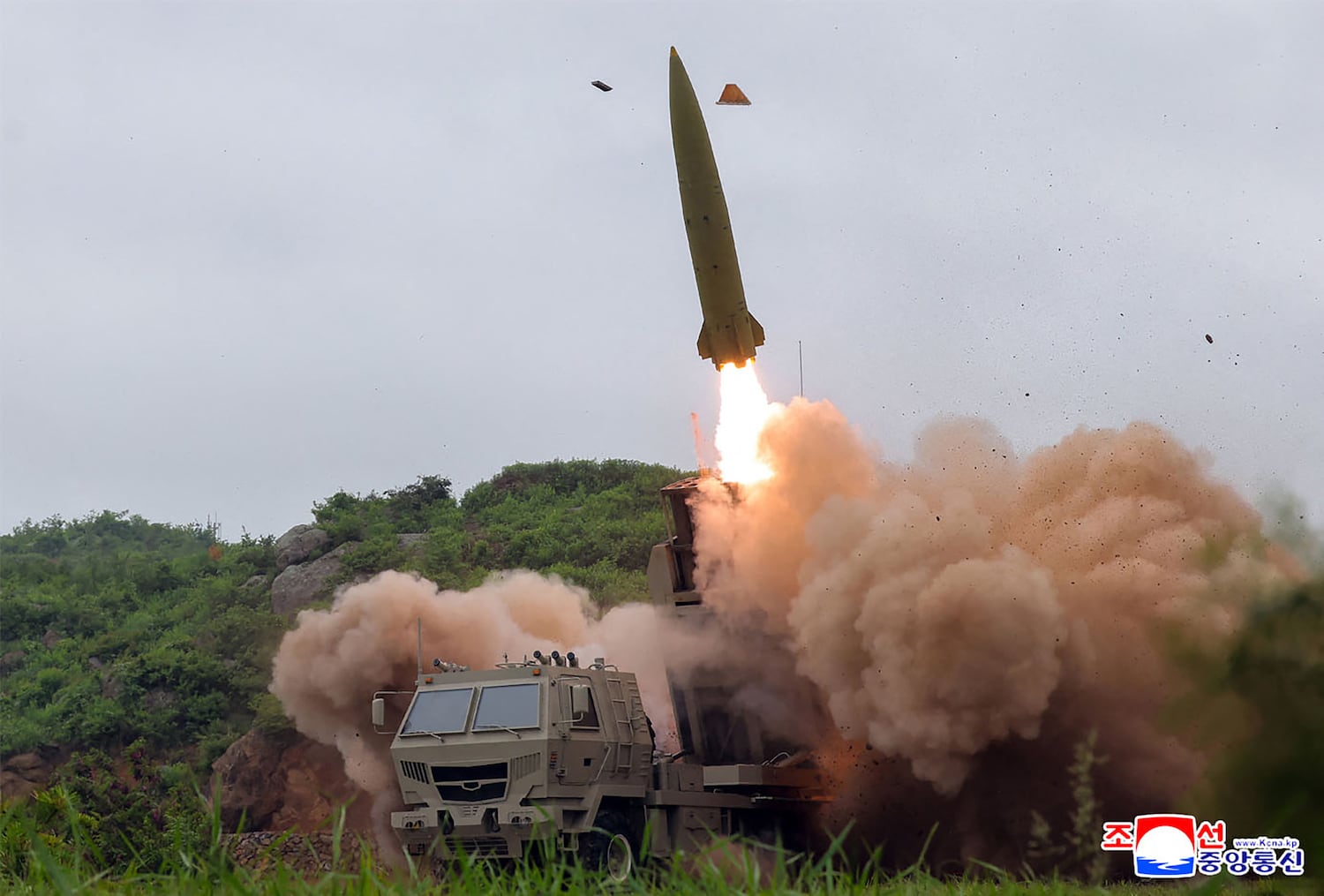
North Korea has constructed at least 21 identical drive-through structures near its border with South Korea that could potentially aid in the operation of truck-based missile or rocket weapons systems, satellite imagery analyzed by Radio Free Asia suggests. Satellite images show 21 newly built drive-through buildings likely designed to shelter launch vehicles. The buildings, each roughly 52 meters (171 feet) long, began to appear in satellite imagery between 2023 and early 2025 at small North Korean Army bases south of Kaesong, just a few kilometers north of the Demilitarized Zone, or DMZ, and only 52 kilometers (32 miles) from Seoul, the capital of South Korea. Their number, design and location suggest they could serve as maintenance and storage facilities for transporter erector launchers, or TELs, or multiple launch rocket systems, or MLRS, two types of weapons systems that can quickly launch guided missiles or rockets against targets across South Korea, experts told RFA. TELs are used in situations where precisely hitting one target is the goal, whereas MLRS is used to attack many targets over a broad area. This picture taken on May 26, 2026 and released by North Korea's official Korean Central News Agency (KCNA) on May 27, 2026 shows North Korean leader Kim Jong Un inspecting tests of a newly-developed lightweight multi-purpose missile launching system and a multiple tactical cruise missile weapon system conducted by the Missile Administration and the Academy of Defense Sciences at an undisclosed location in North Korea. (KCNA via KNS/AFP) The experts noted that neither weapons system has been spotted in imagery but said that the weapons systems infrastructure was the likeliest explanation. “I see no reason for civilian activity at this level of construction in this location,” Joseph S. Bermudez Jr., a senior fellow for imagery analysis at the Washington-based Center for Strategic and International Studies, told RFA. Rockets or missiles? The buildings seem more likely to be for MLRS rather than TEL, Bermudez said. Each building is connected to dedicated access roads designed for military vehicles, but the turning radius appears suitable for smaller vehicles rather than a large TEL. “Multiple rocket launches seem reasonable,” he said. “Multiple rocket launchers grouped in batteries of four would fit, with the ability to have another vehicle — a support vehicle — in there.” Each structure features a central drive-through hall with vehicles able to enter one end and exit the other, and a raised midsection roof tall enough to let a launcher elevate its missile or rocket modules for maintenance, Jacob Bogle, a U.S.-based private satellite imagery analyst, told RFA. “North Korea has been quietly increasing its MLRS infrastructure before making any public announcements,” Bogle said. “These structures are only part of improvements to the DMZ area, but they are among the most potent.” Two of the 52-meter support buildings while they are under construction. The bottom image from 2024 reveals the internal layout of the structures. Analyzed by Jacob Bogle (RFA) Another factor that indicates that the buildings are for TEL or MLRS is that they are so close to the border, Bruce Bennett, a senior national security analyst, told RFA. He noted that North Korean leader Kim Jong Un unveiled 50 new TELs last February capable of carrying 600-millimeter missiles, most likely KN-25s . “Those missiles are just over 8 meters long, so the launchers are likely about 10 meters,” Bennett said. “A battery of three or four such launchers could fit inside one of the 52-meter buildings, one after the other.” The 50 new TELs could potentially fill 13 to 17 of the newly built structures — leaving extra room for the other 600-millimeter systems and shorter-range launchers Kim has separately showcased. Force buildup North Korea has a long track record of sheltering its missile forces in drive-through facilities, experts said. “It even built such facilities for its Scud missiles, but more recently it has been building such facilities even for its longer-range missiles,” Bennett said. Satellite imagery showing two of the completed probable MLRS support buildings, highlighting the multiple roof elevations and driveway approaches common to each of the 21 buildings identified. Analyzed by Jacob Bogle (RFA) Similar drive through structures are present at the nearby Kal-gol missile operating base, according to the ‘Beyond Parallel’ project by the Washington-based Center for Strategic and International Studies. The Kal-gol missile base is one of the most developed of North Korea’s approximately 15-20 undeclared ballistic missile facilities — with a specialized drive-through building with an arched clerestory allows for the elevation of a Hwasong-5/6 missile on a TEL or MEL, or missile erector launcher, for training and maintenance, the report said. To tout his missile capabilities, Kim Jong Un has held three ceremonies since 2022 — most recently this year — unveiling more than 330 newly produced TELs for KN-25 and short-range Hwasong-11D missiles, the latter with a range of just over 100 kilometers (62 miles). “These TELs will mainly be deployed close to the DMZ at a variety of bases because of the short-range of their missiles and this is almost certainly only the beginning of Kim’s deployment of new missiles near the DMZ,” Bennett said. “North Korea is mechanizing its forward forces, so that they could move rapidly forward. It is also a reasonable probability,” Bermudez said. Forward deployment The construction of the drive through buildings also follows Kim Jong Un’s recent push to strengthen frontline firepower. These have included: a February ceremony presenting 600-millimeter multiple rocket launchers, a May order from Kim to reinforce southern border defense, and live-fire tests in June of an upgraded 240-millimeter multiple rocket launcher equipped with autonomous precision guidance and an extended range of up to 90 kilometers (56 miles). Experts say the timing of the new drive through buildings is difficult to view as coincidental. North Korea is “reinforcing its forward-deployed troops,” Bermudez said. “You just don’t build this many structures of the same type unless you’re forward deploying additional assets.” The locations of the 21 MLRS support buildings are grouped into three main sectors near the DMZ, south of the city of Kaesong. Analyzed by Jacob Bogle (RFA) Bogle said the pattern fits a long-standing North Korean survival strategy built on redundancy. “Every new building, every new base, and every underground facility requires the ROK and U.S. to invest even more in building up supplies, and requires more of a burden for intelligence agencies to know what weapons are where at any given time,” he said. Edited by Eugene Whong.
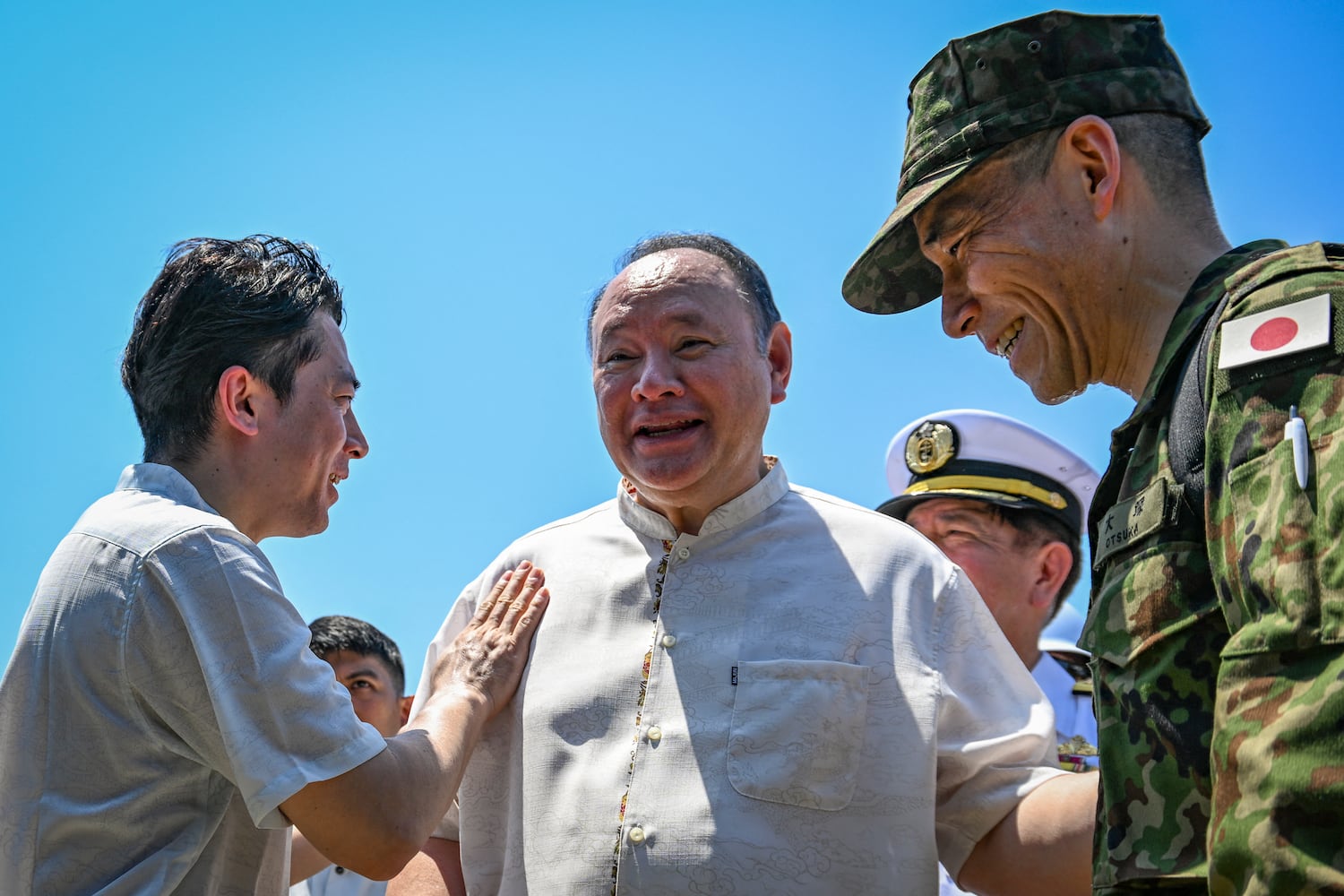
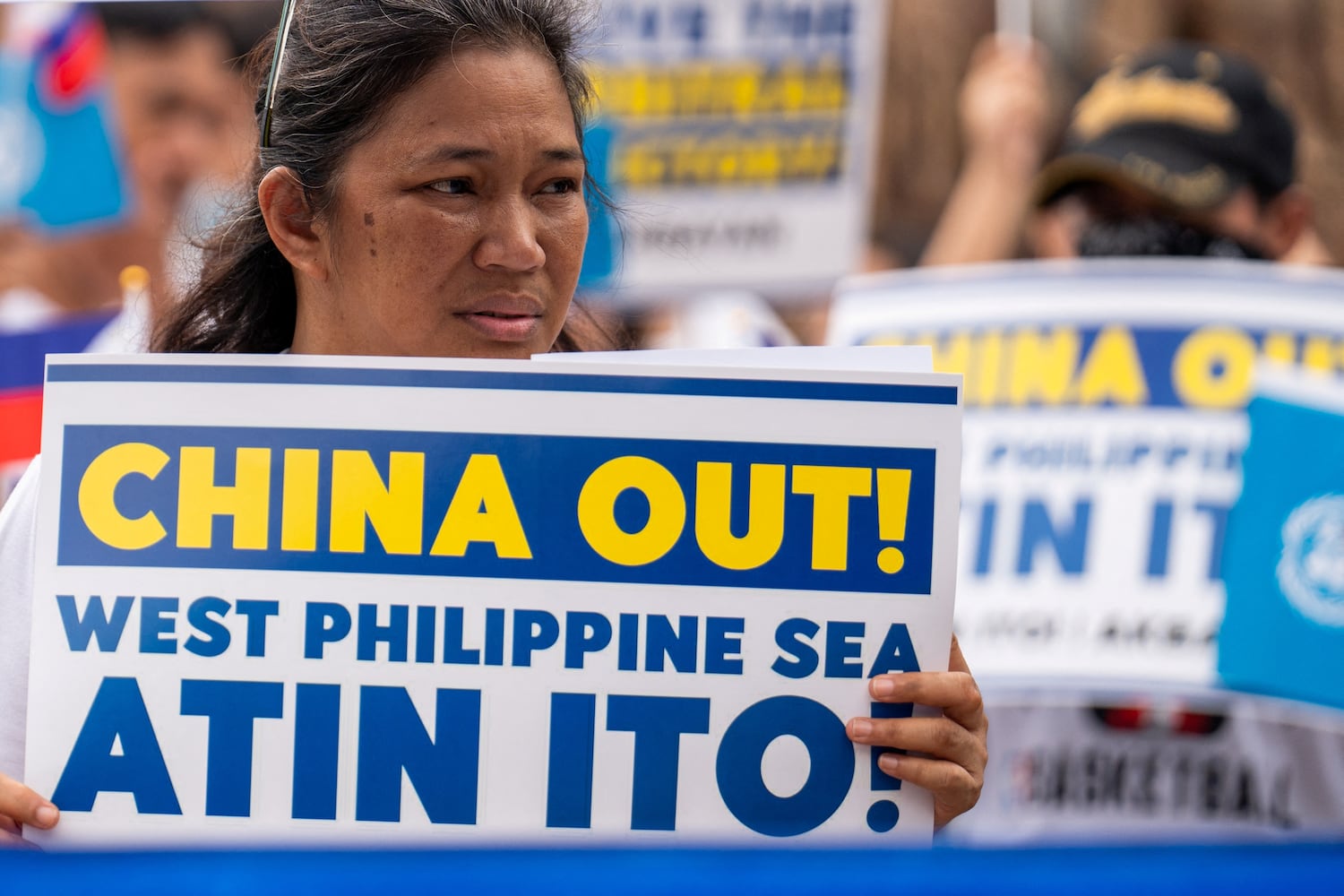
China’s sanctions on a senior Philippine official – and statements that classify him as an apologist for Japan’s wartime aggression – are attempts to drum up historical fears as Manila and Tokyo deepen security ties, analysts told Radio Free Asia. The sanctions on the Philippines’ Defense Secretary Gilberto Teodoro Jr. came last month, when China’s Foreign Ministry accused him of repeatedly making “irresponsible remarks” about China, damaging Chinese interests and undermining bilateral relations, all for comments critical of China’s claims in the sea and aggressive activity there. Japan's Defense Minister Shinjiro Koizumi, left, and the Philippines' Defense Secretary Gilberto Teodoro Jr., after their meeting in Manila, May 5, 2026. (Mark Cristino/AFP) The impact of the sanctions – which forbid Teodoro and his family from entering China and prevent any individuals or organizations from doing business with them – appears limited. Teodoro has indicated he has no intention of traveling to China, raising questions about what Beijing hopes to achieve. But the analysts say that Beijing’s campaign against Teodoro attempts to use the memory of World War II to cast Japan as an aggressor in the Pacific in the modern day – in order to distract from the illegality of Beijing’s claims over the entirety of the South China Sea. “A purely South China Sea argument is difficult terrain for China,” Aniello Iannone, a lecturer in Indonesian and Southeast Asian politics at Diponegoro University in Indonesia, told RFA. Iannone explained that Manila’s claim to its own exclusive economic zone has legal bases under the United Nations Convention on the Law of the Sea, or UNCLOS, a 2016 decision at the Permanent Court of Arbitration that said China’s claim to the whole sea was invalid, and several other legal mechanisms. “Bringing Japan into the picture changes the terms of the dispute,” he said. “It shifts attention away from Chinese conduct at sea and towards a broader political question: what kind of security order are Manila, Tokyo and Washington building in the region?” The case against Teodoro Zhang Junshe of the People’s Liberation Army Naval Military Academic Research Institute offered an unusually detailed case against Teodoro in comments to nationalist-leaning Chinese news and commentary site Guancha. Zhang accused Teodoro not only of “manipulating” and “internationalizing” the South China Sea dispute, but of hyping the “China threat” while “whitewashing Japan’s new militarism,” referring to recent policy shifts in Tokyo that have led to increases in military spending, more active roles in cooperating with allies to counter regional threats, and significant debates over potential changes to pacifist clauses in Japan’s constitution. Zhang juxtaposed these shifts against Japan’s occupation of the Philippines during World War II, going as far as describing Teodoro’s position as “recognizing a thief as one’s father.” Members of the Living History Society, acting as Japanese soldiers, re-enact a scene of the "Battle of the Pockets" between allied and Japanese forces during World War II, at Camp Aguinaldo in Manila on March 25, 2017. (Ted Aljibe/AFP) The Philippines endured a brutal Japanese occupation between 1942 and 1945, a history Beijing regularly invokes in its criticism of Tokyo’s expanding security role. Zhang said Japan was using the Philippines as a “springboard” and “stepping stone” to loosen the constraints of the constitution, expand overseas military deployments and increase its regional military influence. History as a weapon Iannone said China’s use of Japan’s history in the Teodoro case should be understood as political rather than simply commemorative. “Beijing is not just asking Filipinos to remember the Japanese occupation,” he said. “It is using that history to question the legitimacy of Japan’s return as a security actor in Southeast Asia.” Iannone said that China is alarmed by the Philippines’ willingness to work closely with Japan on security matters. “The underlying suggestion is that Japan’s military normalization is not historically neutral, and that Manila is helping rehabilitate a former aggressor by deepening security cooperation with Tokyo.” As part of their closer cooperation, Manila and Tokyo are not only agreeing to cooperate in strategic areas of the South China Sea, they are moving towards talks on the boundaries of their respective EEZs in waters where Taiwan has overlapping claims, Iannone said. The overlapping claims of China and the Philippines in the South China Sea. (AFP) China considers Taiwan as a rogue province, but an integral part of its own territory, so negotiations on boundaries between Japan and the Philippines in these waters without Chinese input would be seen as an affront to the legitimacy of Taiwan’s – and therefore China’s – claims. “From Beijing’s perspective, these are not isolated developments,” Iannone said. “They can be read as parts of a strategic network linking the Philippines, Japan and the United States along China’s maritime periphery.” That creates a complication for Manila, which has sought to defend its South China Sea claims through international law while maintaining its one-China policy and avoiding open involvement in a cross-strait confrontation. “China has an interest in weakening that distinction,” Iannone said. “Once Philippine cooperation with Japan is portrayed as part of a Taiwan-related security architecture, even ordinary maritime cooperation can be recast as participation in a wider containment strategy.” A symbolic target The Philippine government has strongly backed Teodoro in light of the sanctions on him – the Department of Foreign Affairs called the sanctions an “unfriendly act” that would further complicate bilateral relations, while the Philippine military described them as political intimidation and said Teodoro’s statements were grounded in international law. Teodoro said he would continue carrying out his duties and defending the Philippines against what he called China’s “wickedness,” including at sea. China has not specified which of Teodoro’s comments it considered irresponsible, Enrico Cau, a Taipei-based independent security researcher, told RFA. Teodoro’s position, however, has received “strong backing by the Philippines’ political and security establishment.” The support suggests “at least a substantial share of the country’s political and security stakeholders, as well as a vast share of the population likely support such a position,” he said. Philippines' Defense Secretary Gilberto Teodoro Jr., speaks during a bilateral meeting with Japan's Defense Minister Shinjiro Koizumi in Manila, May 5, 2026. (Mark Cristino/AFP) Iannone described the sanctions as “performative coercion” whose direct impact was limited but which sought to shape wider regional calculations. “Teodoro is the immediate target, but the message is aimed at several audiences,” he said. “For Teodoro and the Philippine political class, the message is that China is prepared to personalize diplomatic conflict and impose costs on officials who speak bluntly about Chinese coercion or advocate closer security cooperation with Japan and the United States.” Punishing Teodoro is therefore not the objective, Iannone said. “The aim may not be to make Teodoro change his position,” he said. “It may be to make others think twice before adopting the same tone.” Cau noted that China overusing sanctions to try to silence its critics – especially in ways that have limited effect – carries a risk of undermining the threat of future sanctions. Iannone, meanwhile, said that the sanctions on Teodoro may in fact have the opposite of their intended effect. “In the Philippines, where distrust of China is already substantial, the sanction can reinforce his image as someone prepared to defend Philippine sovereignty,” he said. Edited by Eugene Whong.
Updated July 12, 2026 at 12:16 a.m. ET. MANILA, Philippines – As the Philippines marks the 10 th anniversary of an arbitration ruling it won against China in the disputed South China Sea this weekend, analysts told Radio Free Asia that Manila should counter Beijing’s continued aggression in the disputed area through diplomatic means, while Philippine military officials called for deterrence with the help of allies. The 2016 ruling at the Permanent Court of Arbitration in the Hague established that China’s Nine Dash Line – which encircles the South China Sea to claim it as Chinese territory – has no basis in international law. Manila celebrates the anniversary of the ruling on July 12 each year, calling it “West Philippine Sea Victory Day,” after what it calls the region of the sea that lies within its exclusive economic zone, or EEZ. “The Department of National Defense joins the Filipino community in celebrating the 10th Anniversary of the 2016 Arbitral Award, a landmark ruling that affirmed the Philippines’ rights and entitlements in its Exclusive Economic Zone,” Defense Secretary Gilberto Teodoro said in a statement Saturday. The overlapping claims of China and the Philippines in the South China Sea. (AFP) China continues to reject the outcome of the ruling, and has spent the last 10 years stepping up its island-building activities in the mineral-rich sea region. It actively controls areas within the Philippines’ EEZ including Scarborough Shoal. But it has no answer to the ruling, Rafaela David, co-convenor of the civilian-led Atin Ito Coalition, a group that advocates for Philippine sovereignty, told RFA. “Missiles cannot substitute for legal arguments, and military intimidation cannot rewrite international law,” she said, alluding to China’s test of a submarine-launched ballistic missile earlier this week. “No act of coercion can erase this historic victory. We will continue to stand firm, defend the West Philippine Sea, and safeguard the rights and future of generations of Filipinos.” Though the ongoing dispute has seen heated moments – such as China firing water cannons and pointing potentially blinding laser guns at Filipino forces – the Philippines should continue to employ peaceful methods to sway public opinion to its cause, Francis Rico Domingo, a political analyst at the state-run University of the Philippines, told RFA. “The Philippines needs to continue pushing back against China using diplomatic means,” he said. “This involves filing diplomatic protests as often as possible and exposing China’s illegal activities to the public and the United Nations.” Expanded deterrence The court’s ruling in 2016 cements the Philippines’ legal foundation in the perennially disputed sea, Military chief General Romeo Brawner Jr. said Friday at a forum that gathered security experts in Manila, but he argued that more collaboration with “like-minded forces” led by the U.S. in deterrence efforts. To that end, he called for improvement in Manila’s deterrence capabilities. He said that while advanced military equipment is needed there must be “national resolve to stand firm in defense of what is rightfully” Philippine territory. Philippine military chief Gen. Romeo Brawner speaks at military headquarters in Manila, Oct. 3, 2025. (Ted Aljibe/AFP) “Our objective has never been to provoke conflict,” he told the forum. “Our objective is to prevent conflict by making it clear that the Philippines has both the resolve and the capability to protect its sovereign rights in accordance with international law.” Brawner said the security environment in the disputed area continues to evolve. “We continue to face illegal, coercive, aggressive and deceptive tactics,” Brawner said, adding that these activities “seek to alter the status quo while remaining below the threshold of armed conflict.” A Su-30 fighter jet from China’s Southern Theater Command is seen flying over Scarborough Shoal in the South China Sea on Dec. 29, 2024. (Southern Theater Command) Brawner said that the Philippine military’s “assertive transparency” strategy – thoroughly documenting Chinese aggressive actions and provocations and revealing them to the world – must continue. “Through our policy of assertive transparency, we document unlawful incidents, verify the facts and make them known to the Filipino people and to the international community,” he said. “We do this not to escalate tensions. We do it because truth matters. Transparency strengthens accountability. It reinforces the rules based on international order and it denies those who employ coercive actions the ability to shape the narrative through deception.” Shift in Focus Though the military may be equipped for deterrence in the disputed sea, the public might not be used to it in this role, Domingo said. Two years ago the Philippine military shifted from its role as an internal force meant to quell insurgencies and keep the peace domestically to the Comprehensive Archipelagic Defense Concept, or CADC, focused on defense from external threats and protecting territorial sovereignty. The concept “has been frequently mentioned, but the public is not aware of what the strategy is and how it really works,” Domingo said. Because China rejects the arbitration ruling, Manila must “permanently engage other countries to strengthen its capacity to defend itself from external aggression.” But Domingo said that the Philippines also needed to engage Beijing diplomatically, and had to publicly acknowledge that every tension must be deescalated. For the CADC to be effective, the Philippines must review outdated military and defense concepts “to add the importance of protecting our sovereign rights, territorial integrity and sovereignty,” Teodoro said at the forum on Friday. A Dec. 4, 2024 photo shows a China Coast Guard ship, right, deploying a water cannon at the Philippine Bureau of Fisheries and Aquatic Resources vessel BRP Datu Pagbuaya near Scarborough Shoal in disputed waters of the South China Sea. (National Task Force for the West Philippine Sea via AFP) Teodoro said adjustments in the posture are under review because currently the Philippines’ is still focused on “land-based, post-invasion defense” that was still a product of post-World War II strategy. He called for a bump on the country’s defense budget, and noted that even Indonesia, which has a separate territorial dispute with China, looks to increase its defense spending to acquire new hardware. “I would like to see a visible economic dividend from the West Philippine Sea that we all worked for, if unilaterally or in convergence with those who have truly helped us,” he said. Popular support In Teodoro’s Saturday statement, he noted that 86% of Filipinos were in support of Manila working with other countries to defend its territorial sovereignty. “We will seek not only to increase public knowledge of the West Philippine Sea, but also to ensure that this knowledge strengthens our national resolve and resilience,” he said, vowing to “resist and combat” any attempts to deny the country its rights in its EEZ, “For these are not only ours to protect, but also those of future generations of Filipinos.” The 10th anniversary of the landmark 2016 court ruling comes weeks after scholars affiliated with the Chinese government said at an academic symposium that the Philippines does not have legal sovereignty over the Batanes, a group of islands that lie north of the Philippines’ largest island of Luzon which have been administered continuously by the Philippines or its predecessor states since the 18th century. The academics argued that the Batanes are “a natural geographical extension of Taiwan,” which China considers a renegade province. Edited by Eugene Whong. Update adds comments from Rafaela David.
Ocean of Peace Alliance open for others to join, but could it lead to a NATO-style military bloc?
When Australia and Fiji signed a mutual defense treaty this week, a key component of the agreement was that other Pacific island countries could join. Experts told Radio Free Asia that this was a sign that Australia is providing much needed leadership in the region. The Ocean of Peace Alliance, signed Monday in Suva by prime ministers Sitiveni Rabuka of Fiji and Anthony Albanese of Australia, requires that in the event of an attack on either country, both would “act to meet the common danger.” Though the exact wording of the treaty does not absolutely require both sides to mobilize their military forces in such a situation, it still ties the security of the two countries together more closely than their previous agreements, the experts said. The treaty “marks the continued march of Australia’s diplomacy,” Alan Tidwell, director of the center for Australian, New Zealand and Pacific Studies at Georgetown University in Washington, DC, told RFA. Is the Fiji-Australia Alliance the start of the Pacific version of NATO? (RFA Video) “Internationally, the treaty signals to competitors that Australia is leading an effort to align parties in a Westerly tilt,” he said. Tidwell noted that the alliance is the latest in a series of agreements with several Pacific Island countries including Tuvalu, Nauru, Papua New Guinea, and Vanuatu. “Australia has firmly established itself as the standard bearer of Western engagement with Pacific Island democracies in the South Pacific.” The Ocean of Peace Alliance is Fiji’s first, and Australia’s fourth – Canberra signed a bilateral defense treaty with Papua New Guinea in 2025, and with the United States and New Zealand in 1951. Hours after Rabuka and Albanese signed the treaty, China’s foreign ministry spokesperson Mao Ning told reporters during a press conference that Beijing hopes that “the country concerned” would respect the Pacific island countries’ independence. “China always upholds the principles of mutual respect, equality, mutual benefit, openness and inclusiveness in carrying out cooperation with Pacific island nations,” she said. “We do not engage in geopolitical rivalry or seek selfish political gains.” Pacific NATO? On Thursday, Newsweek published a report that suggested that opening up the alliance for others to join could lead to a South Pacific version of NATO to counter China. Sailors stand on board HMAS Canberra, facing the Opera House in Sydney, Australia, March 21, 2026. (Hollie Adams/Reuters) With Australia in an alliance with the United States, and Washington in its own alliances, in theory the mutual defense clause could be triggered by events far away from either Fiji or Australia. But several experts told RFA that that the prospect was unlikely. Republic of Fiji Military Forces personnel practice servicing cargo for transport with a member of the Royal Australian Air Force during the Australian International Airshow in Avalon, Australia March 26, 2025. (Hollie Adams/Reuters) “I would not say that this treaty is the start of a major defense bloc like NATO,” Kathryn Paik, deputy director and senior fellow with the Australia Chair at the Washington-based Center for Strategic and International Studies, or CSIS, told RFA. “However, the flexibility built into this agreement to allow additional partners points to Australia’s creativity in crafting fit-for-purpose agreements and treaties throughout the region to continue to build out the regional security architecture.” She said that it allows Pacific Island countries more power in decisions regarding their own defense. “If others join – especially other Pacific Island nations – it will demonstrate an increasing prioritization of Pacific-led security agreements and the need for collective defense in the face of potential external threats,” Paik said. Though the language of the treaty sounds similar to NATO’s Article 5, the Ocean of Peace Alliance, even if joined by other countries, would be fundamentally different, Gregory Brown, director of the Alliance Futures Initiative, a Washington-based think tank, told RFA. “Just like NATO, you are required under the alliance and under the treaty to consult your constitutional processes in the event of an attack on either one,” he said. “Australia doesn’t have to defend Fiji as if it’s Australia and Fiji doesn’t have to defend Australia as if it’s Fiji. They’re required to take it back to their constituent processes to respond in some fashion.” Ocean of Peace The name of the Ocean of Peace Alliance gets its name from Rabuka’s central foreign policy platform, which advocates for the Pacific countries to address challenges like climate change, geopolitics and strategic competition through consensus and cooperation, while rejecting coercion and militarism. Rabuka also hoped to apply the principles of Fiji taking a “friends to all and enemies to none” approach to navigating regional competition between China and the United States. Leaders of Pacific island nations at the Pacific Islands Forum summit in Honiara, Solomon Islands, on Sept. 11, 2025. (Ben Strang/AFP) In 2025, leaders of the Pacific Islands Forum adopted the “Blue Pacific Ocean of Peace Declaration,” based on Rabuka’s vision. But Brown said the Ocean of Peace Alliance is somewhat of a departure from Rabuka’s earlier messaging. “I think maybe Rabuka has been reading Aristotle who, a couple thousand years ago, told us that ‘friends to all’ means ‘friends to none,’” he said. “In fact what Rabuka has decided is that ‘I’m going to sign a mutual defense treaty,’ which by definition is a departure from just friends to all.” “He’s identified a threat to Fiji and he’s decided to align his security with one set of partners against that threat,” said Brown. “For me, that’s not a betrayal of Fijian sovereignty. It’s an exercise in strategic autonomy.” In addition to signing into the Ocean of Peace Alliance, Australia and Fiji also signed into effect the Vuvale Union, another treaty-level agreement that integrates the two countries economically. Hours after the agreements were signed, China fired an intercontinental-range ballistic missile into the South Pacific Nuclear Free Zone, in what experts told RFA was a message to U.S. allies, but which Beijing said was a routine test. New Zealand’s Prime Minister Christopher Luxon said in a statement Thursday that Wellington would discuss with Suva and Canberra about the prospect of joining the alliance. Edited by Charlie Dharapak.
Myanmar’s military-backed government removed or destroyed at least 15 statues of Gen. Aung San, who led the country to independence from British rule and was the father of jailed former State Counselor Aung San Suu Kyi, residents tell Radio Free Asia. Since former general Min Aung Hlaing was sworn in as Myanmar’s new president in April, the removal of statues of Aung San in public areas have increased in Magway, Bago, Yangon, Ayeyarwady, Sagaing, and Mandalay regions, according to an RFA tally. Women show the three-finger salute as they carry portraits of Aung San Suu Kyi and her father, general Aung San, during a protest against the military coup and to demand the release of elected leader Suu Kyi, in Yangon, Feb. 7, 2021. (Reuters) In June, authorities demolished a bronze Aung San statue in Zee Kone, Bago Region. On July 1, officials demolished one statue in Mya Kan Thar Park in Thaketa Township and two statues in Thumingalar Park in South Okkalapa Township, Yangon, fencing them off. Residents tell RFA government authorities are monitoring the sites so that no one can take photos. The military-backed government took issue with media reports including one published Thursday by RFA Burmese that documented the disappearance of the statues. “Some media outlets are currently reporting the removal of General Aung San statues in certain areas. In reality, not all statues of General Aung San are being removed; rather, only statues with incorrect proportions and shapes are being reviewed and handled in accordance with the law,” said government spokesperson Khaing Khaing Soe in a statement published on Friday. For months, the military-backed government hadn’t commented on why the statues were being removed. Statues of Gen. Aung San were erected around the country between 2015 and 2020 during the government led by Aung San Suu Kyi’s National League for Democracy, or NLD. In a July 8 statement the NLD said that it had participated in the construction of the statues in accordance with the will of the people and with the contributions of individual citizens in accordance with the law. They are destroying his statues “because Gen. Aung San left his daughter Aung San Suu Kyi for the Burmese people,” said Bo Bo Oo, a vice chairman of the NLD. “The dictator... is attacking the statues as well as oppressing the citizens,” he said, referring to Min Aung Hlaing. “Nevertheless, Aung San will always be in the hearts of the people.” A Feb. 13, 2015, photo shows Aung San Suu Kyi speaking in front of a statue of her father General Aung San to mark his 100th birthday anniversary in his hometown of Natmauk, in Magway district of central Myanmar. This statue was not among those removed. (Soe Zeya Tun/Reuters) A politician from Tharyarwady, who did not want to be named for security reasons, criticized the wiping of Gen. Aung San’s image from public display, including de-circulating banknotes with his image, as an act of successive military dictatorships. “Gen. Aung San was erased from the public eye for several years, resulting in the boom and rebirth of his role in history in recent administrations, starting from the Thein Sein government to the time of ‘our mother’ Aung San Suu Kyi, from vinyl pictures to papers. And finally during the rule of Aung San Suu Kyi, there have been many statues of the general. There have been many in every neighborhood and city.” He said that so many statues of Aung San felt like a “punch to the gut” for many of the previous military leaders. Government officials announced that a special exhibition will be held at the General Aung San Residence Museum in Natmauk, Magway region, for the Martyrs’ Day celebration on July 19, and that the public is welcome to visit. “Gen. Aung San is a very important figure in the history of Myanmar’s independence struggle,” government spokesperson Khaing Khaing Soe said in a statement. “Therefore, in order to ensure that the statues of the general are kept in accordance with their dignity, and that future generations can study and preserve the historical value and tradition correctly, they are being reviewed in accordance with The Protection and Preservation of Ancient Monuments Law 1962.” Translated by Kyaw Min Htun. Edited by Charlie Dharapak and Eugene Whong.